By Emiliano Fracchia, DevOps Cloud Executive at Cloudgaia
DevOps maturity refers to the level of sophistication in an organization’s processes, tools, and knowledge related to the Salesforce development lifecycle. Analyzing these three components (Process, People, and Tools) helps identify areas for improvement and to elevate an organization’s maturity level along the DevOps path. This path involves using various tools and techniques for development, deployment, and quality tasks. Moving up through the maturity levels aims to improve the speed and quality of releases, delivering value to end users faster and more efficiently.
There are different models of maturity levels that you can follow, but all of them are focused on 5 stages with similar concepts in each of them. We will focus on a model with stages of DevOps maturity ranging from Baseline to DevOps CI/CD, each with distinct characteristics.
The following diagram shows the DevOps maturity level path for Salesforce development lifecycle:
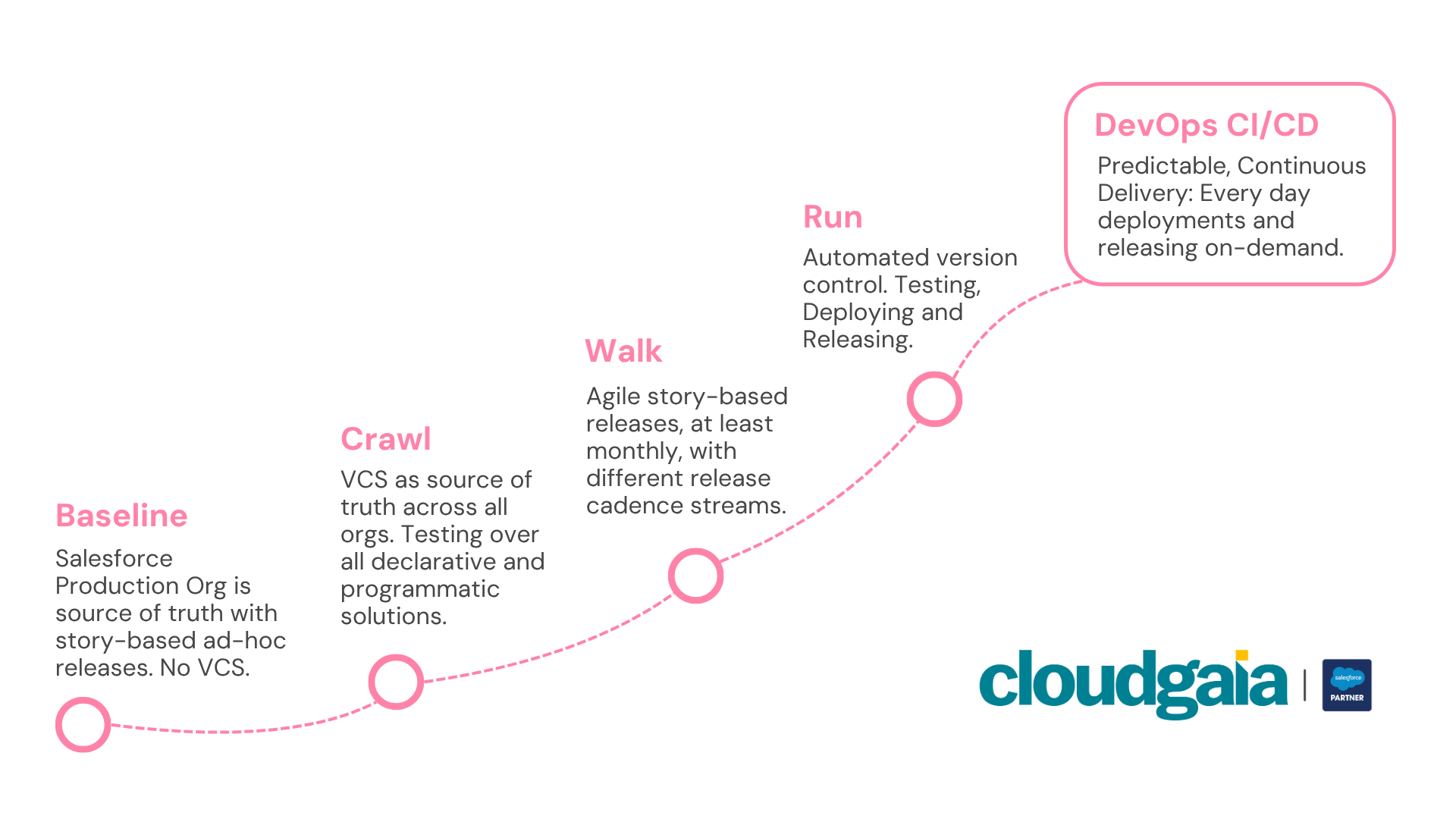
DevOps Maturity Levels for Salesforce Development Lifecycle
Level I – Baseline: Establishing Foundations
At the Baseline level, we assume that the organization uses Application Lifecycle Management (ALM) tools that help to organize the requirements and the lifecycle of the development. These tools could be just a spreadsheet or an advanced platform like Jira, Trello, etc.
The use of them lets the team create user stories with a standard structure that specifies the requirements, technical specifications, and acceptance criteria.
At this level of maturity, we can identify these characteristics:
- The source of truth is the Production Org.
- There are changes being done manually in Production.
- There is no Version Control System (VCS) in place, like git repositories.
- Lack of Testing plans.
- No automations.
- Limited and informal communication between developers. No tools for collaboration.
- Slow deployments, frequent errors, and difficulty in reverting changes.
This stage is common for small teams using Salesforce for basic configuration and customizations. As your team and customizations grow, it’s time to move to the next level.
Level II – Crawl: Building Structure and Traceability
At this level, two major improvements are introduced:
- Repository as the source of truth, enabling traceability and simplifying rollbacks and code reuse.
- Testing methodologies for higher-quality releases and reduced rework costs.
The first one provides traceability of all changes and development being done, with specifics as to who made the changes and when, making it easier to revert any change or even to re-utilize useful code for other developments. Any manual change in the Org will be overwritten by the code in the repository, as this last one is the new source of truth.
The second important improvement is the implementation of Testing methodologies for all the development being done, following Salesforce recommendations, so that the quality of the releases increases drastically, decreasing the re-work required by identifying errors in higher environments that end up causing a higher cost. It is much cheaper to identify and fix errors early in lower environments than later in production.
Characteristics at this level:
- The source of truth is the repository. Most changes are deployed from there.
- Minimum manual changes, only for metadata not supported by the Metadata API.
- Testing procedures start in lower environments.
- Possibility to automate some tasks from the repository.
- Use of the repository for collaboration within the Team.
- Slow deployments, fewer errors, and the ability to revert changes due to the change of the source of truth.
Teams at this level are developing a small to medium customized functionality, with several team members who need to work on components at the same time, as well as to test the functionality before going to production. User acceptance testing is required, so there are Sandboxes for development and a UAT environment for testing.
Pro Tip: We recommend reviewing Agentforce Deployment: Are You Ready for Production? for further insights on optimizing your deployment processes.
Level III – Walk: Embracing Agile Methodologies
At this level, DevOps practices expand, with the organization adopting Agile methodologies. Implementing frameworks like Scrum organizes development into sprints and defines releases according to a clear backlog of finished and tested features, ready to be deployed.
Characteristics at this level:
- Agile methodology implemented.
- Use of ALM tools to organize the stories, sprints, epics, and releases, as well as to increase communication and collaboration.
- Better communication within the team.
- Release calendar, with at least monthly releases.
- Clear release scope.
- Clear understanding of tests required in each of the environments, as well as UAT sign-off for the stories included in the release.
- Regular deployments, a decrease in errors in production, an increase in quality, and rollback plans are set up for each release.
This is the ideal level for organizations with ongoing Salesforce customizations and production support. Processes and communication are well-established, and a PM or Scrum Master facilitates project visibility and agile methodology adoption. Most DevOps best practices are implemented, including continuous integration from multiple development streams into an integration environment, continuous delivery with regular production deployments, and continuous feedback loops incorporating additional testing environments like QA/INT and UAT. While this level represents a significant achievement, the demand for faster improvements and cost optimization requires further advancement.
Level IV – Run: Driving Efficiency Through Automation
The Run level is focused on automation. Every stage of the process involves at least some kind of automation that improves efficiency and decreases human errors.
Teams with this level of maturity generally have automated integration between code in the repository and deployment to an integration environment, with minimum human intervention. There are automated tests put in place, like component validation, code coverage, and static code analysis. There are Quality Gates set up as part of the Master Test Plan, and Release processes established with required approvals to move from Dev Environments through UAT and Production.
At this level, the teams focus on automating any process that requires repetitive steps.
Characteristics at this level:
- Agile methodology is well established.
- Automations for code merge, validation, and deployment to upper environments.
- Automations for code test, static code analysis, and regression testing.
- Use of scripts to replace required manual tasks in Production.
- Communication channels integrated with DevOps tools to visualize user story status, test results, release scope, and status, etc.
- Release calendar, with weekly releases.
- Regular deployments with high-quality results.
- Minimum defects in production and almost no rollbacks or hotfixes required.
This level of maturity represents a stage where teams are used to DevOps practices and embrace those processes. Automation and time optimization are part of their daily thoughts.
Considerable return on investment can be seen, as well as good metrics for deployment frequency and delivery quality. Very mature teams are at this level.
Level V – DevOps CI/CD: Continuous Improvement
This stage, DevOps CI/CD, represents the pinnacle of DevOps maturity. One of the fundamental concepts of DevOps is Continuous Improvement, and defining a top-level maturity feels like you’ve gotten to the top, and there shouldn’t be a finish line in this journey; we need to always seek opportunities for improvement.
That is why this stage is purely based on improvements to guarantee successful and efficient continuous integration and continuous delivery.
Characteristics at this level:
- Continuous integration process and automation set up in lower environments.
- Early detection of defects and fast resolution before reaching UAT.
- Continuous delivery, with the possibility of daily deployments to Production or based on demand.
- Mature agile ways of work.
- QA processes are established and automated.
- Good communication and collaboration within the team, with the help of tools that guarantee visibility of the workflow.
- Mature teams are looking for efficiency in their daily tasks and automation of repetitive processes.
- Continuous improvement mindset.
Teams at this level of maturity can spend part of their day, or even a full sprint, developing and implementing improvements. While you might have done this previously, it likely required significant effort to comply with other best practices. Now, the development lifecycle operates smoothly, providing the team with the clarity, visibility, and focus needed to innovate.
Conclusion: Evaluate Your DevOps Maturity
Now that you have an overview of each DevOps maturity level, evaluate where you are in your Salesforce journey. By improving People, Tools, and Processes, you can scale your operations, enhance release quality, and drive customer satisfaction.
If you need help getting started or advancing in your DevOps journey, don’t hesitate to reach out. At Cloudgaia, we have experience supporting organizations of all sizes, from small to large global enterprises, across industries like consumer goods and financial services.
Ready to elevate your DevOps maturity?
Let us know. Talk to a Cloudgaia expert and discover how Cloudgaia can guide you through the Salesforce transformation journey.