
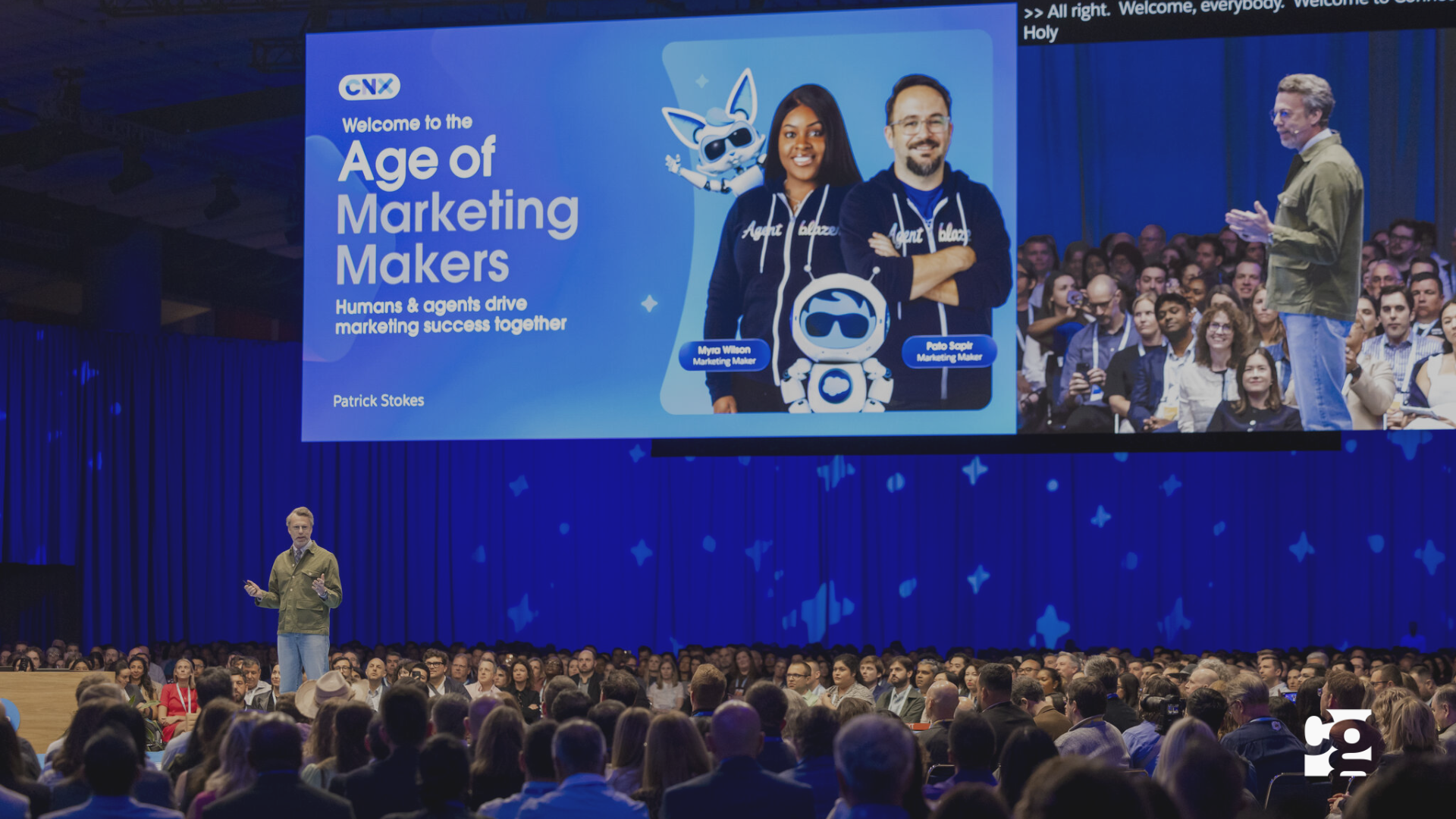
Salesforce Connections 2026 opened in Chicago with a strong signal for marketing teams. Salesforce is still betting on a future where humans and agents work together, and during CNX 2026, that vision became much more concrete for marketers.
The Main Keynote focused on Agentforce Marketing and introduced a new operating model: The Age of Marketing Makers, where marketers can work with agents to analyze data, coordinate work, generate content, optimize campaigns and move pipeline faster.
For enterprise teams, this is bigger than a product announcement. It is a shift in how marketing work gets designed, governed and scaled.
At Cloudgaia, we see this as a foundation-first conversation. Agents can move fast, but the value they create depends on the quality of your data, the clarity of your business definitions, the strength of your architecture and the way your teams work together.
Agentforce Marketing and the Age of Marketing Makers
The keynote positioned the Age of Marketing Makers around three major ideas.
- Always-on creativity.
- Self-optimizing campaigns.
- Autonomous pipeline generation.
This framing matters because the biggest constraint for marketers is not a lack of ideas. It is the operational weight around those ideas. Salesforce pointed to a familiar reality for marketing teams. Campaigns can still take 12 to 14 weeks to launch, involving more than 100 internal touchpoints across teams, channels, approvals, data requests and content workflows. That is a coordination problem.
The promise of Agentforce Marketing is to reduce the distance between idea, decision and action. Instead of marketers waiting on disconnected reports, manual handoffs or fragmented approvals, agents can support the work around insight generation, campaign setup, content creation, optimization and follow-up.
That does not remove the need for human judgment. It raises the importance of it.
Marketers still define the goal, the audience, the creative direction, the business guardrails and the final decision. Agents support the execution layer and help teams move faster with more context.
Agentforce Coworker and Slackbot for real-time marketing intelligence
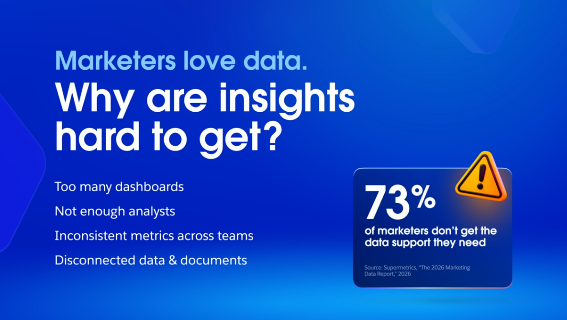
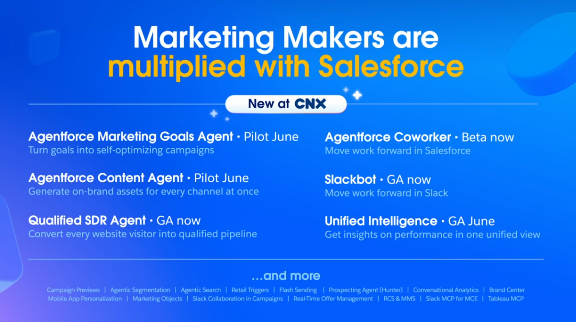
The first major product focus was always-on creativity, powered by Agentforce Coworker and Slackbot.
Salesforce highlighted a critical data pain for marketers. 73% of marketers do not get the data support they need. That often means too many dashboards, too many metric definitions and not enough analyst capacity to turn information into action.
Agentforce Coworker was presented as a data analyst, marketing strategist and data engineer in one. In the demo, it used a semantic layer to understand business-specific metrics, analyze a decline in Marketing Driven Pipe and recommend which programs to cut or protect based on funnel output.
That semantic layer is important. It means the agent is not just looking at data. It is interpreting data through shared business context.
Slackbot brought a similar experience into the flow of work. In the keynote, Slackbot generated an executive summary for a QBR by combining CRM data, unstructured Slack context and Tableau visualizations in one conversation.
For marketing leaders, this is where AI starts to move from assistance to operational intelligence. The opportunity is not just faster reporting. It is faster alignment around what is happening, why it matters and what the team should do next.
At Cloudgaia, we help organizations prepare the data foundation and business definitions that make this possible. Without that foundation, agent outputs can become generic. With the right structure, they become actionable.
Agentforce Marketing Goals Agent and Agentforce Content Agent for self-optimizing campaigns
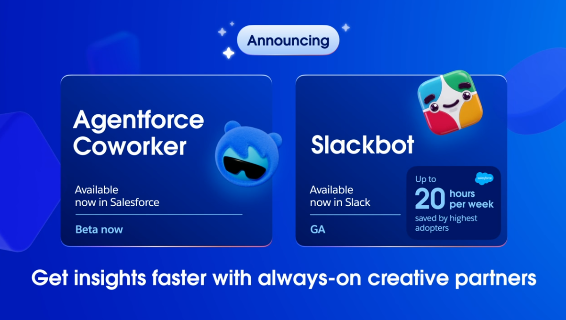
The next major focus was campaign execution. Salesforce introduced Agentforce Marketing Goals Agent and Agentforce Content Agent as new capabilities designed to help marketers build, launch and optimize campaigns with greater speed and control.
The challenge is clear. Campaigns are still slow to move from concept to market. That 12 to 14 week campaign cycle and timeline mentioned previously creates risk. By the time a campaign launches, the audience, context or business priority may already have changed.
Agentforce Marketing Goals Agent is designed to turn goals, audiences, budgets and guardrails into a campaign that can be built, launched and optimized. In the keynote demo, the agent recommended audience opportunities, built a campaign object and later suggested a channel optimization based on performance signals.
The marketer could set guardrails around budget, channel changes and approval flows. The agent could recommend optimizations, but the human remained accountable for the strategy and the decision.
Agentforce Content Agent focused on the content layer. It generated on-brand assets across channels and used customer data to support more relevant offers and experiences.
This is where the difference between generic AI content and enterprise-ready AI content becomes clear. A generic tool can generate copy. An agent grounded in customer data, campaign context, brand rules and channel logic can create content that is closer to the actual business need.
For Cloudgaia, this is one of the most important takeaways from CNX 2026. Self-optimizing campaigns only work when the campaign engine, data model, content operations and approval flows are connected.
Contentful and the next content layer for Agentforce Marketing
Salesforce also announced a definitive agreement to acquire Contentful, a composable content platform and headless CMS.
If marketers are expected to create more personalized, omnichannel and AI-assisted experiences, they need a content layer that can scale. Content cannot stay locked inside disconnected pages, apps or manual production workflows.
A composable content platform can help marketers manage content in a more modular way, so assets, messages and experiences can be reused and adapted across channels.
For Salesforce customers, the strategic implication is clear. Content is becoming part of the agentic marketing architecture. Data, journeys, campaigns, content and channels need to work as one connected system.
This is where deep Salesforce architecture matters. Adding agents without rethinking the content and data foundation can create more complexity. Connecting the foundation first can turn Agentforce Marketing into a real growth engine.
Qualified, Piper and Hunter for autonomous pipeline generation
The final major section of the keynote focused on B2B marketing and autonomous pipeline generation.
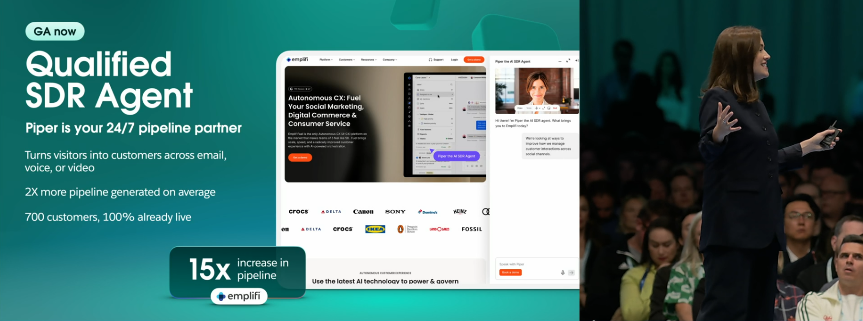
Salesforce introduced Qualified and its AI SDR Agent, Piper, as a 24/7 pipeline partner. Piper works on the website and in the inbox to engage buyers, qualify intent, answer questions, surface relevant content and book meetings.
The pain is urgent for B2B teams. Salesforce highlighted that 78% of buyers choose the vendor that replies first, and the keynote also referenced that B2B companies take an average of 42 hours to follow up with an inbound lead. That delay can turn demand into lost pipeline.
Piper is designed to compress the gap between interest and action. Instead of waiting for a human follow-up hours or days later, the agent can engage the buyer immediately, understand context and move the opportunity forward.
The keynote also introduced Hunter as a prospecting agent for outbound motions. Together, Piper and Hunter show how Salesforce is expanding the agentic model across the revenue funnel.
For B2B marketers, this does not eliminate the sales team. It changes the handoff. The goal is to make sure humans enter the conversation with better context, stronger qualification and less delay.
Key Takeaways
| Agentforce Marketing is moving from vision to operating model | The keynote showed agents supporting real marketing workflows, from insight generation to campaign optimization and pipeline generation. |
| Agentforce Coworker and Slackbot bring intelligence into daily work | Teams can move from fragmented dashboards to faster recommendations, summaries and visualizations in the flow of work. |
| Agentforce Marketing Goals Agent and Agentforce Content Agent target campaign speed | Salesforce is addressing the operational drag behind campaign planning, content creation and optimization. |
| Contentful strengthens the content foundation | Personalized, agentic experiences need content that can scale across channels and contexts. |
| Qualified, Piper and Hunter expand agents into pipeline generation | B2B marketers can reduce follow-up delays and engage buyers faster across website, inbox and outbound motions. |
| Foundation-first is now critical | AI agents perform better when data, architecture, metrics, governance and workflows are already aligned. |
| Humans stay in control | Agentforce Marketing supports human teams with recommendations, automation and execution, while people define strategy, approvals and business judgment. |
Conclusion
Salesforce Connections 2026 made one thing clear. Agentforce Marketing is not just about launching more AI agents. It is about changing how marketing teams create, coordinate, optimize and generate pipeline.
The Age of Marketing Makers points to a future where marketers work with agents across the full marketing lifecycle. They can move from scattered data to real-time intelligence, from slow campaign production to self-optimizing campaigns, and from delayed follow-up to faster pipeline generation.
For companies already using Salesforce, the next question is not whether AI will change marketing. It is whether their Salesforce ecosystem is ready to capture that value.
At Cloudgaia, we help companies turn Salesforce innovation into measurable growth through deep platform expertise, adaptive speed with AI and value from the first call.
Talk to our experts and turn Agentforce innovation into growth.
Frequently Asked Questions (FAQ)
What is the Age of Marketing Makers?
It is the model Salesforce introduced at Connections 2026, where each marketer works alongside a team of AI agents that handle analysis, content, campaign execution, and pipeline qualification. The marketer keeps control of strategy and approvals while the agents remove the coordination overhead that slows campaigns down. The agents work alongside people, never in place of them.
What is Agentforce Coworker and how is it activated?
Agentforce Coworker is an agent embedded in Salesforce that diagnoses performance and recommends actions in minutes, grounded in your data through the semantic layer. It requires no IT project, runs on Flex credits, and is included in Agentforce for Sales, Agentforce for Service, and Salesforce Foundations. It is currently available in beta.
How fast can the Qualified SDR agent go live?
On average 45 days, because configuration happens in the Qualified Studio in natural language with no code. All 700 plus customers are live in production, and B2B teams generate around twice the pipeline compared to human-only follow-up.
Does agentic marketing replace marketing teams?
No. Every agent announced at Connections 2026 is designed to work alongside people. The agents automate the predictable and repetitive work and escalate the complex decisions to humans, who keep control of strategy, creativity, and final approvals. That balance is what makes the model usable in real enterprise environments.