
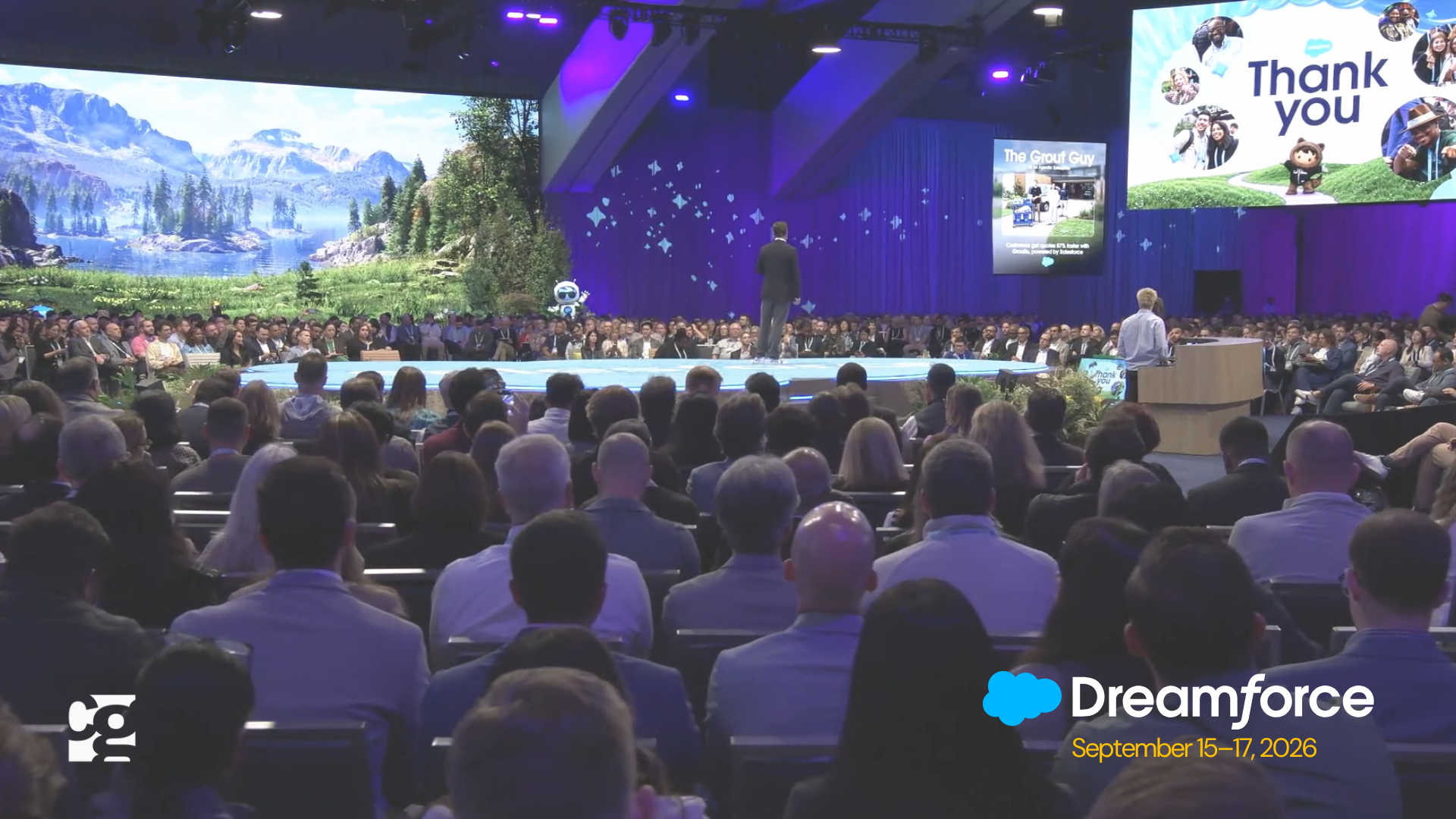
Dreamforce 2026 didn’t just talk about agentic AI, it showed the receipts. In the Agentforce Keynote, “From Fast Start to Real ROI,” Salesforce EVP Mark Wakelin opened with a promise: the next fifty minutes would be less about vision and more about proof. Now in our tenth year at Dreamforce, the Cloudgaia team was in the room as three live customer demos walked through exactly how real businesses are turning Agentforce into measurable value. Here is what business leaders need to know.
The Agentic ROI Playbook: Three Steps to Real Value
Wakelin framed the entire session around a simple equation.
“There are really only two ways to generate ROI. The first is to increase revenue and the second is to reduce cost.”
Mark Wakelin, EVP, Agentforce, Salesforce
Everything else, he said, is a derivative of those two levers, and the only real obstacle is a company’s ability to execute with focus and speed. That is the logic behind Salesforce’s agentic ROI playbook, a three step approach that structured the entire keynote:
- Pick a use case and deploy it fast.
- Customize and extend that use case across the enterprise.
- Observe and optimize the agents in real time.
Wakelin backed the framework with scale: more than 30,000 customers are now live on the Agentforce platform, and customers voted it the number one AI agentic platform on G2 this year. The three live demos that followed, one per step, gave that scale a human face.
It’s a framing that matches what Cloudgaia sees every day in client engagements: the fastest path to ROI is rarely the boldest one. It’s the one that starts narrow, proves value quickly, and expands from there.
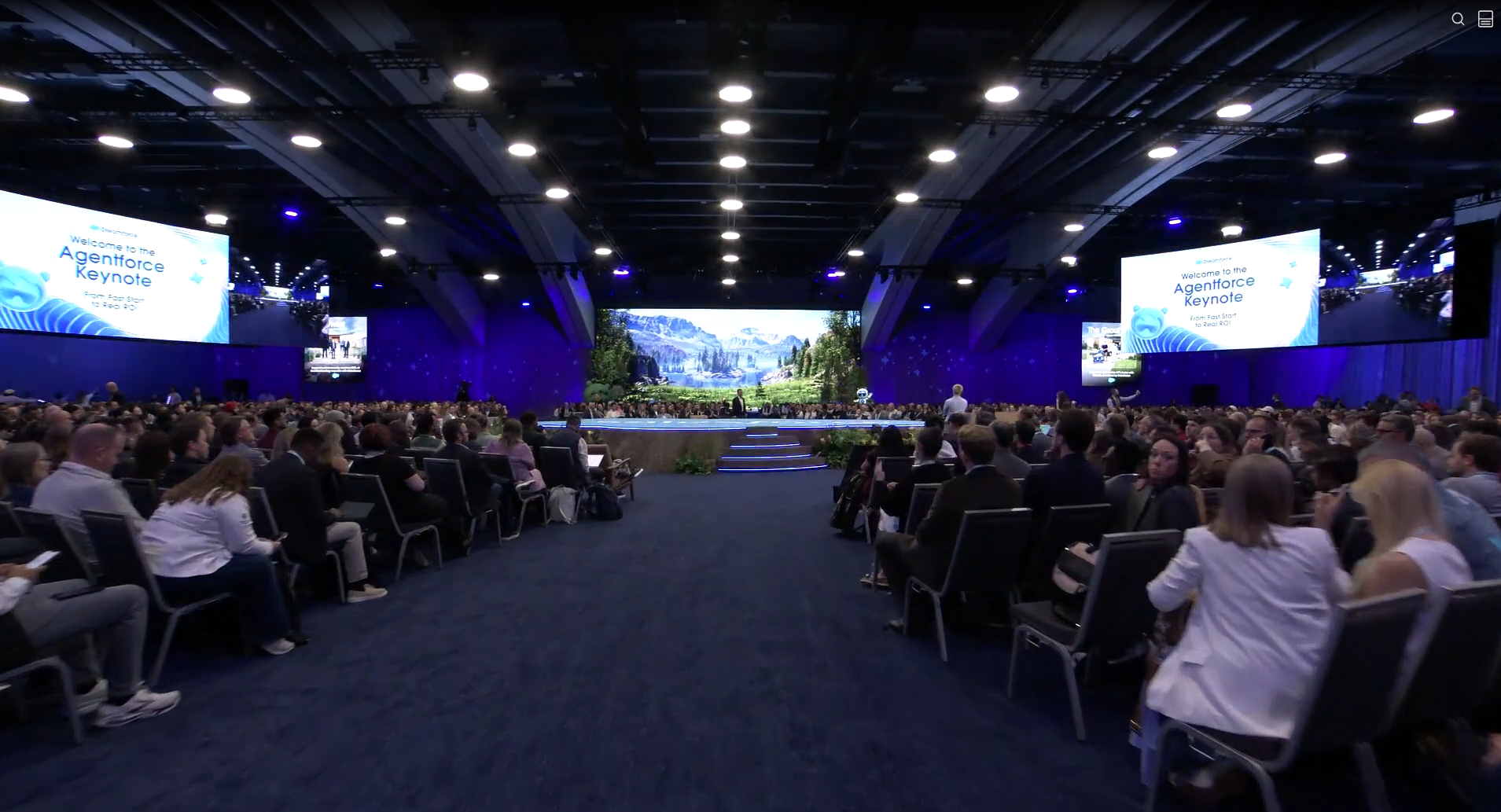
Fast Start: From First Login to Live in One Hour
The first stage of the playbook, picking a use case and deploying it fast, came to life through Agentforce Coworker. Avanthika Ramesh, Director of Product Management, Salesforce AI, who led this section, put the challenge plainly.
“Speed doesn’t come from skipping the foundation. It comes from starting on the right foundation.”
Avanthika Ramesh, Director of Product Management, Salesforce AI
One company went from first hearing about Agentforce to having it live in one hour. Its power users were testing it within a week, and within six weeks, more than 3,000 employees were using Agentforce day to day. The tool at the center of that speed was Agentforce Coworker, an autonomous AI teammate that understands a company’s business from day one and works across surfaces, including headlessly inside Claude, that is, working directly from the Claude interface without switching tools.
The live demo showed a commercial sales leader using Coworker for an end of quarter pulse check: scanning pipeline data, scoring relationship health across an entire portfolio, and surfacing stalled deals in seconds, work that used to mean hours of manual digging through financial statements and account files. From there, the team built a skill, a reusable set of instructions that Coworker can run and rerun, turning a one time analysis into a repeatable, shareable process across the organization.
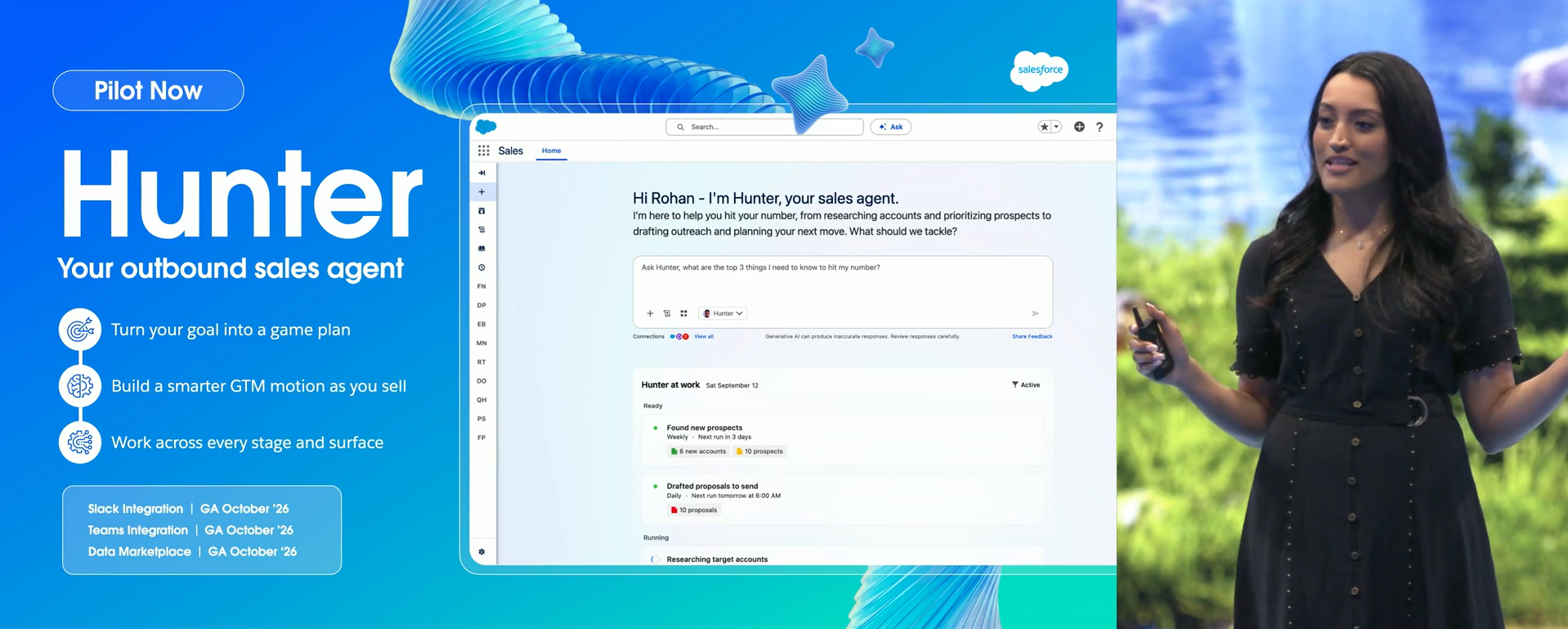
The keynote then introduced Hunter, Agentforce’s outbound sales agent, currently in pilot with general availability expected in November 2026, built on a new long-horizon runtime designed to hold a goal over days or weeks instead of a single conversation. In the demo, Hunter identified $340,000 in at-risk pipeline, built a task plan, connected to Gmail to learn the user’s voice, and drafted an outreach email ready to send, all while continuing to adapt as new context came in.
The results shared on stage speak for themselves: 80,000 hours saved, more than $389 million in new business generated, and customer issues resolved four days faster.
Customize and Extend: Building Super Agents with Agent Script
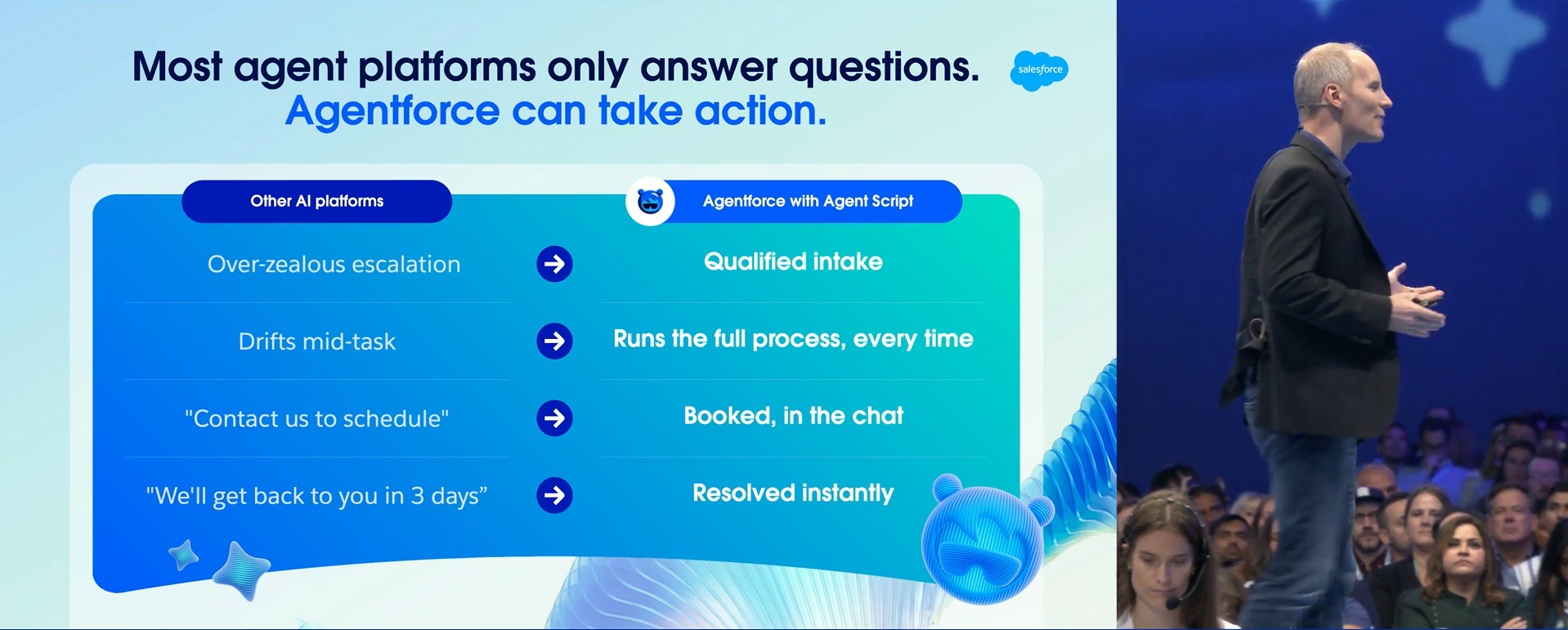
Chief Product Officer John Kucera opened the second stage of the playbook with a direct contrast: where other platforms escalate too quickly, drift mid-task, or push customers toward a phone call in three days, Agentforce agents qualify intake, execute the full process, and deliver instant results.
The live demo that followed showed how far customization and extension can go once an organization moves beyond simple FAQ agents into agents that take real action. It walked through a routine account request, the kind some companies receive 25,000 times a month, that used to take five to ten minutes per case to resolve manually. Built with Agent Script, the sub-agent checks business rules before acting, validates uploaded documents deterministically through MuleSoft, extracts the relevant fields automatically, and creates a case for human follow up when needed.
That sub-agent is one of several that, together, form what Salesforce calls a super agent: independent teams building and owning their own agent use cases, unified through multi-agent orchestration into a single, consistent brand experience for the customer. On stage, the results were millions of dollars in productivity and a 7X return on investment.
Observe and Optimize: A First Look at Agent Optimizer
The final stage of the playbook, led by Susannah Plaisted, Director, AI Product Marketing, Salesforce, tackled a question every enterprise eventually asks: once agents are live, how do you know they are still working the way you expect? Traditional software has a predictable release cycle measured in weeks and months. Agents, she explained, need something faster.
“IT teams need to work with the business together to observe and optimize over the course of hours and days, not weeks and months.”
Susannah Plaisted, Director, AI Product Marketing, Salesforce
The live demo showed Agentforce Observability in action: an alert flagged a call where a customer asked for help the agent wasn’t yet configured to provide. The team used that insight to add the missing capability headlessly in Claude, tested it using the public Agentforce Development Lifecycle skills repository, and deployed the fix, all part of a continuous loop that Plaisted described as turning Observability into compounding ROI. The results were tangible: 20% chat containment, lower friction, and higher CSAT. Plaisted also confirmed a notable pricing change: Agentforce Observability is now unmetered, meaning full visibility across every agent and every conversation comes at no additional cost.
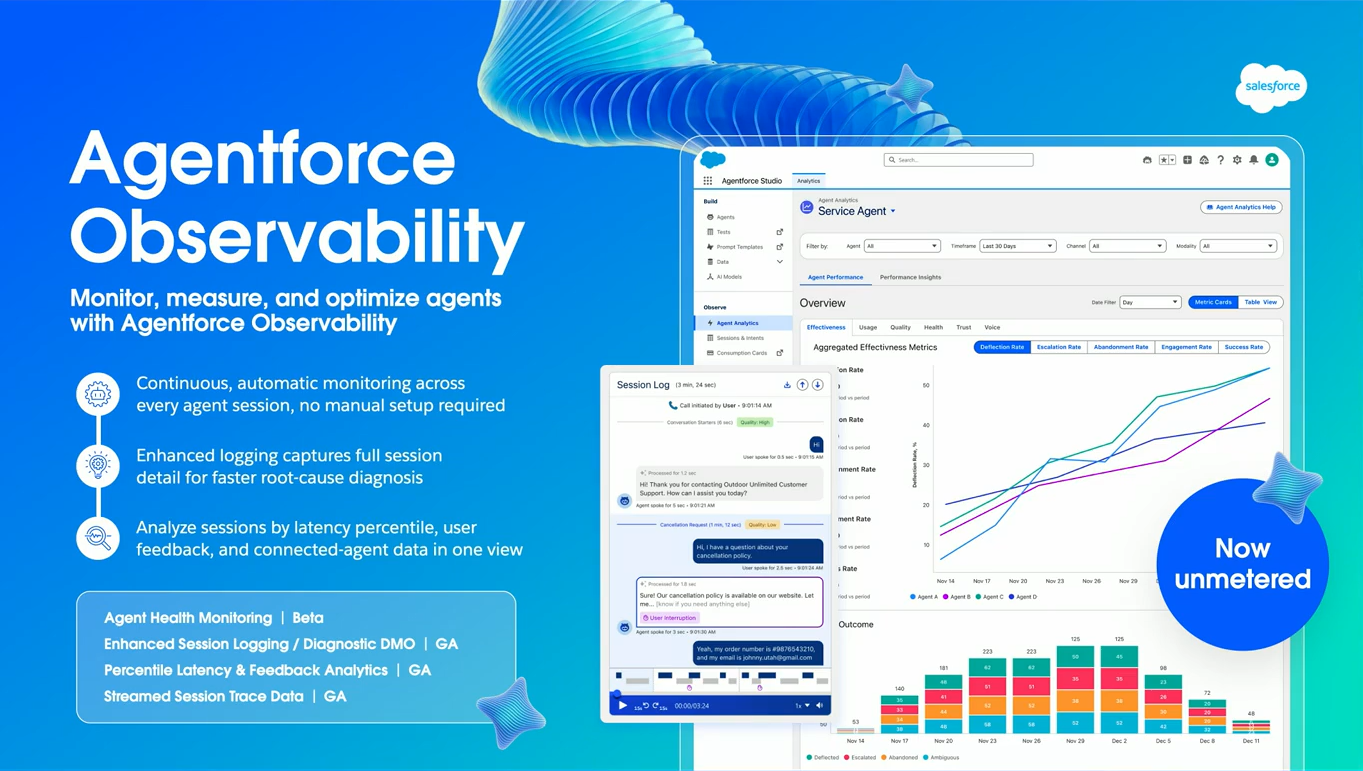
The section closed with a first look at Agent Optimizer, a new capability inside a reimagined Agentforce Studio. Instead of agent managers hunting through reports and logs, Optimizer surfaces proactive alerts ranked by business impact, identifies the root cause of an issue, drafts a plan with the reasoning behind each change, runs its own tests, self corrects if a test fails, and lets the team roll out the fix gradually, all inside a single conversation.
“This is truly the future of Agentforce.”
Susannah Plaisted, Director, AI Product Marketing, Salesforce
Real ROI Starts with the Right Foundation
Across all three stages of the playbook, one thread held steady: none of these results came from moving fast and improvising. They came from starting with a focused use case, building on a platform that already understood the business, and treating optimization as a continuous discipline rather than a one time project. That is exactly the path Cloudgaia walks with clients every day: identify the use case that maps to a real bottleneck, deploy it on a solid foundation, and keep observing and refining once it’s live.
Whether you are evaluating Agentforce Coworker, planning your first long-horizon agent, or thinking about how to extend and unify agents across teams, our team can help you move from pilot to measurable ROI.
Cloudgaia already works on both sides of this story: we implement Agentforce as part of our Salesforce practice, helping clients choose the right first use case, extend it responsibly, and keep it delivering value long after launch. And because so much of this keynote happened headlessly inside Claude, it’s worth saying: Cloudgaia already helps clients bring Claude and Agentforce together, including through Salesforce’s new Claudeforce experience. If this keynote left you wondering where to start, that’s the conversation our team has every day.
Key Takeaways
- Salesforce’s agentic ROI playbook has three steps: pick a use case and deploy it fast, customize and extend it, then observe and optimize continuously.
- Agentforce Coworker is a headless, multi-surface AI teammate that understands a business from day one and can be reached from inside Claude.
- Hunter, Agentforce’s outbound sales agent, runs on a new long-horizon runtime built to pursue goals over days or weeks, not just a single conversation.
- Multi-agent orchestrated “super agents” let independent teams build and own their own sub-agents while a single, unified brand experience stays intact for the customer.
- Agentforce Observability is now unmetered, and Agent Optimizer, shown for the first time, turns agent optimization into a guided, self testing, one conversation process.
Q&A
What is Agentforce Coworker?
Agentforce Coworker is an autonomous AI teammate built on the Agentforce platform. It understands a company’s business context from day one, takes action on a user’s behalf, and works headlessly across surfaces, including inside Claude.
What is a long-horizon runtime?
It’s a new way for an agent to operate, remembering where it left off, adapting its plan as new information comes in, and pursuing a goal over days or weeks instead of completing a single task in one conversation. Hunter is the first Agentforce agent built on it.
What are “super agents”?
They are a way for independent teams, each responsible for a different part of the customer experience, to build and own their own sub-agents while Agentforce’s multi-agent orchestration presents customers with one unified, on brand experience.
What is Agent Optimizer?
Shown for the first time at this keynote, Agent Optimizer is a new Agentforce Studio capability that identifies the root cause behind an agent issue, drafts a plan for the fix, runs its own tests, and lets teams roll out changes gradually, all inside one conversation.
Where should my business start?
Most organizations start by picking one use case tied to a clear bottleneck and deploying it on a pre-built, generally available agent like Casey, with Hunter reaching general availability in November 2026, then treating observation and optimization as an ongoing discipline rather than a one time step.