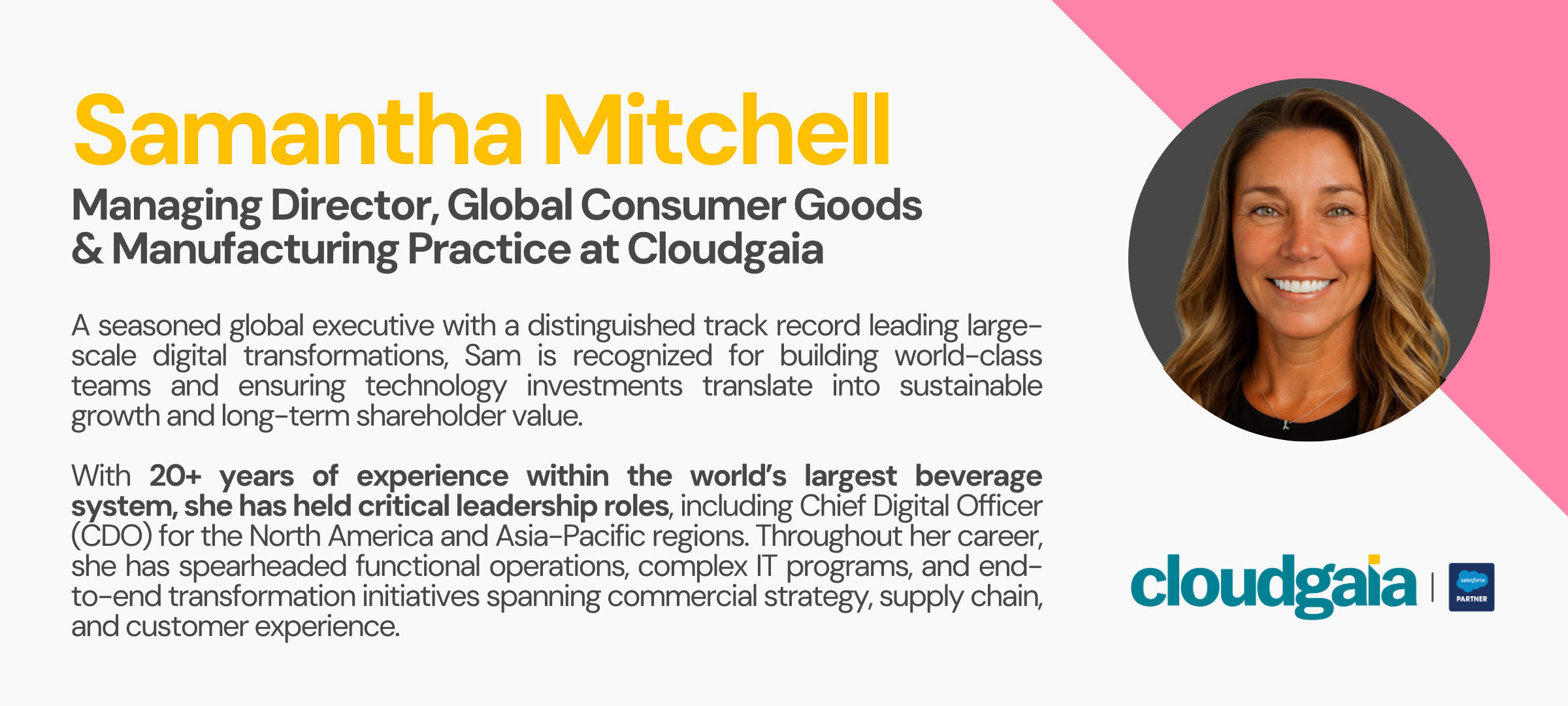

By Samantha Mitchell Managing Director, Global Consumer Goods & Manufacturing Practice at Cloudgaia
AI is currently dominating boardroom conversations across the Consumer Goods industry. From retail execution and demand planning to supply chain orchestration, organizations are moving quickly to embed intelligence into their operations.
But after three decades in this industry—leading digital and commercial strategies across global systems—I’ve seen a consistent pattern: AI delivers impact only when it is grounded in real digital transformation.
The most critical question for a CPG leader is not how fast AI can be deployed, but whether the organization is ready for the commercial orchestration that AI requires.
Why This Is a Critical Moment for CPG Leaders
The industry is at an inflection point. We are facing structural pressure: compressed margins, rising omnichannel expectations, and fragmented routes-to-market. While AI promises productivity gains, it also exposes organizational fragility.
The cost of inaction is high, but the cost of rushing without a foundation is higher:
- Fragmented Models: If your commercial operating model is disjointed, AI will simply scale that fragmentation, leading to channel conflict and inconsistent pricing.
- Data Trust: Poor data quality undermines rep trust at the shelf and destroys adoption before it even begins.
- Compliance Risk: AI deployed without governance increases compliance exposure and operational noise.
Today, 88% of brands report they are not comfortable with their current omnichannel strategy (Dreamforce 2025). This is a clear signal that channel presence alone is not translating into coordinated execution. Transformation is the mechanism required to turn this complexity into Margin Expansion and ROIC improvement.
Transformation Before Automation
When organizations talk about becoming “AI-first,” I encourage them to pause and reframe the conversation. AI in Consumer Goods is often discussed in terms of use cases: predictive analytics, autonomous agents, personalization. While these capabilities are powerful, they only deliver value when they impact the bottom line—specifically through Working Capital impact, Trade Spend efficiency, and Cost-to-Serve optimization.
The companies that succeed don’t start with automation; they start with alignment. They recognize that:
- Orchestration > Automation: Automation reduces task effort, but orchestration aligns cross-functional workflows—ensuring AI agents coordinate sales, trade, and supply chain actions to protect margins.
- Unified Platforms Matter: Composable point solutions often optimize isolated functions but create “integration drag.” A unified platform (like Salesforce Customer 360) with a single data model ensures AI agents operate on real-time data, eliminating reconciliation delays.
- Incentives Matter: You must redesign KPIs to reflect new AI-enabled behaviors.
True digital transformation in Consumer Goods focuses on how decisions are made across the value chain; how commercial, supply chain, service, and digital teams collaborate; how execution is monitored and corrected in real time; and how technology supports outcomes, not functions.
Having led multi-market commercial and digital transformations across global beverage systems I’ve learned that when AI is introduced into a well-aligned operating model, adoption accelerates naturally. When it’s introduced into structural misalignment, resistance follows. AI amplifies whatever foundation it is built on. Transformation ensures that foundation is strong.
Digital Transformation as a Foundation
Digital transformation is an enterprise-wide shift in how an organization operates, competes, and delivers value. It is enabled by technology, but it is driven by leadership and new ways of working.
To turn strategy into measurable value, we must integrate five essential dimensions:
- Leadership & Strategy: Clear outcomes and executive sponsorship where leaders are aligned on shared goals.
- Operating Model & Ways of Working: Redefining how work gets done, how decisions are made, and how value flows across the chain.
- Business Processes & Capabilities: End-to-end processes designed around outcomes, not organizational silos.
- Change, Adoption & Culture: Aligning mindsets, skills, and incentives to the future state.
- Technology Enablement: Using platforms, data, and automation to support the model, not dictate it.
Failure in any one of these dimensions slows the entire journey. Technology is a powerful accelerator, but mindset and execution determine the actual value realized.
Beyond Tools: Creating a Scalable Capability
When we talk about AI and tools like Agentforce, we are looking at a fundamental shift in how work gets done. They can reduce manual effort and improve execution consistency. However, agents cannot compensate for broken processes.
The companies seeing measurable impact are doing three things differently:
- Redesigning operating models before deploying autonomous agents.
- Aligning incentives to new execution behaviors.
- Prioritizing enterprise-grade decisioning over fragmented insights.
Through our advisory practice at Cloudgaia, we help CPG organizations move beyond technology implementation. We focus on embedding change into governance, KPIs, and workflows. The goal is to build a sustainable operating model where AI-enabled execution becomes part of how the organization runs—turning digital transformation into a true competitive advantage.
AI is a multiplier. If your foundation is strong, it will multiply your growth. If it is weak, it will only multiply your inefficiencies.
If you’re exploring how to move your business from isolated pilots to scalable AI, let’s discuss how to align your foundation for the road ahead.