
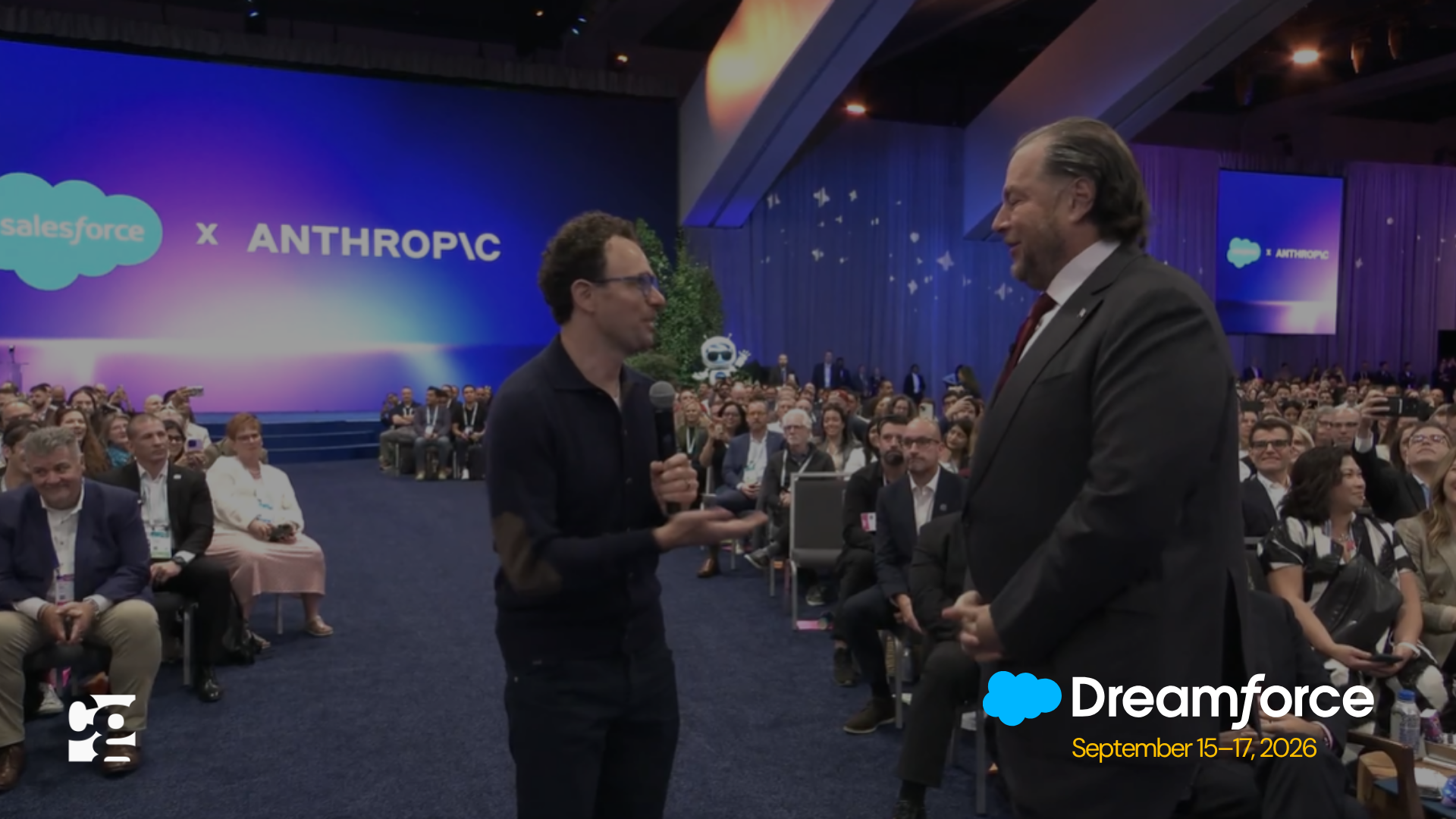
If there is one thing Salesforce can be counted on to do, it’s to keep surprising its ecosystem; and this year’s Main Keynote delivered. Now in our tenth year at Dreamforce, the Cloudgaia team was on the ground in San Francisco as Salesforce CEO Marc Benioff laid out the next chapter of the Agentic Enterprise. This year’s headline reveal was AIforce, a new live interface layer for Salesforce, alongside an expanded family of ready-to-deploy Agentforce agents and a sharper focus on trust as the real foundation of enterprise AI. Here is what business leaders need to know.
The Agentic Enterprise: AIforce Meets Agentforce, Customer 360, and Data 360
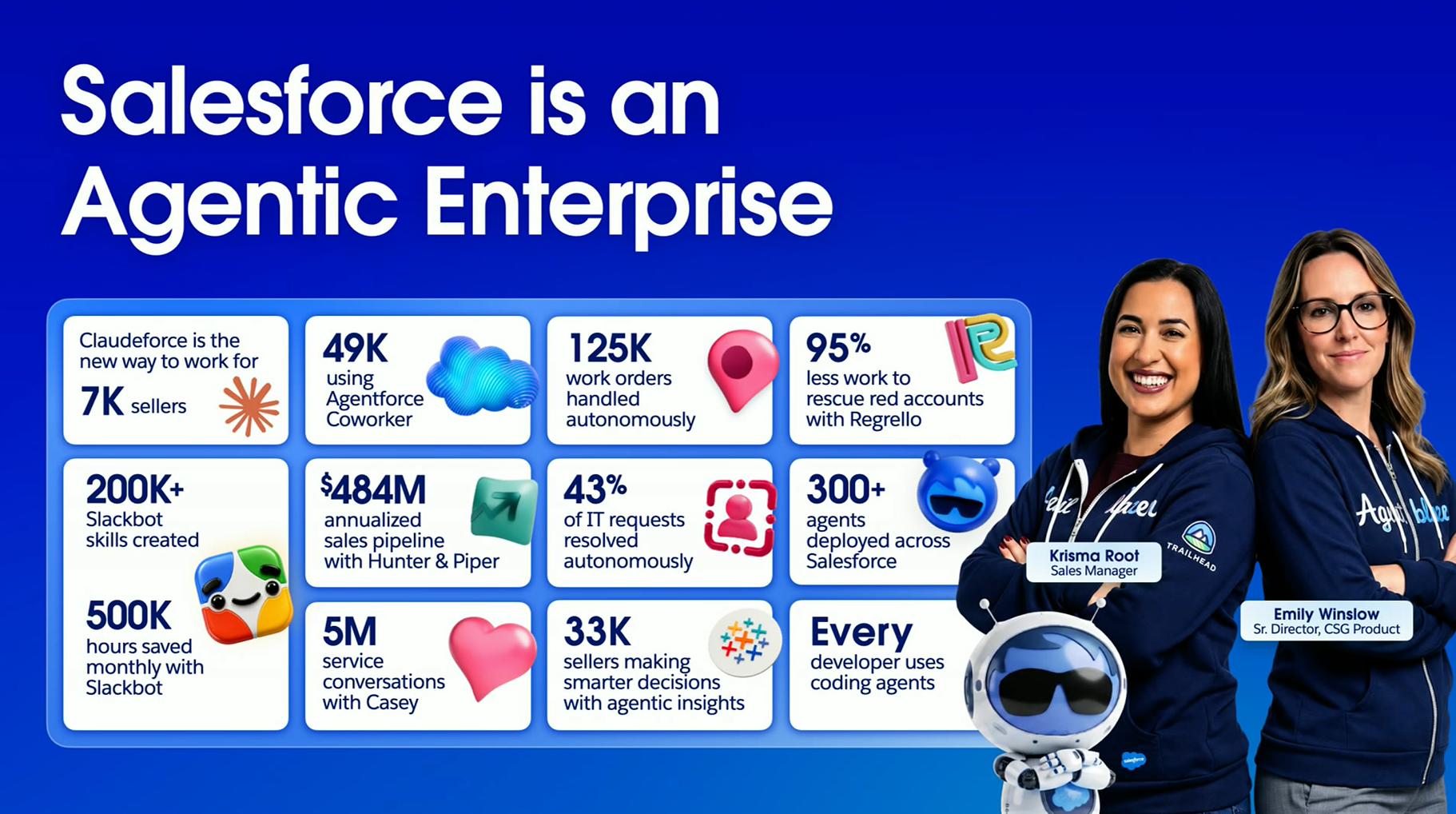
Benioff opened by pointing to Salesforce’s own operations as proof of concept. The company already runs thousands of internal users on its new AI interface, and agents like Hunter and Casey are handling real production work: generating pipeline and resolving millions of service conversations. The framing was clear from the first minutes: every company, not just Salesforce, can become an Agentic Enterprise.
The idea running through the keynote is what Benioff called “trapped value”: the insight, patterns, and context that already live inside a company’s Salesforce data, waiting to be unlocked by an AI layer that actually understands the business.
It’s a framing that matches what Cloudgaia sees every day in client engagements: most organizations already own the data they need; what they’re missing is the layer that turns it into decisions and actions.
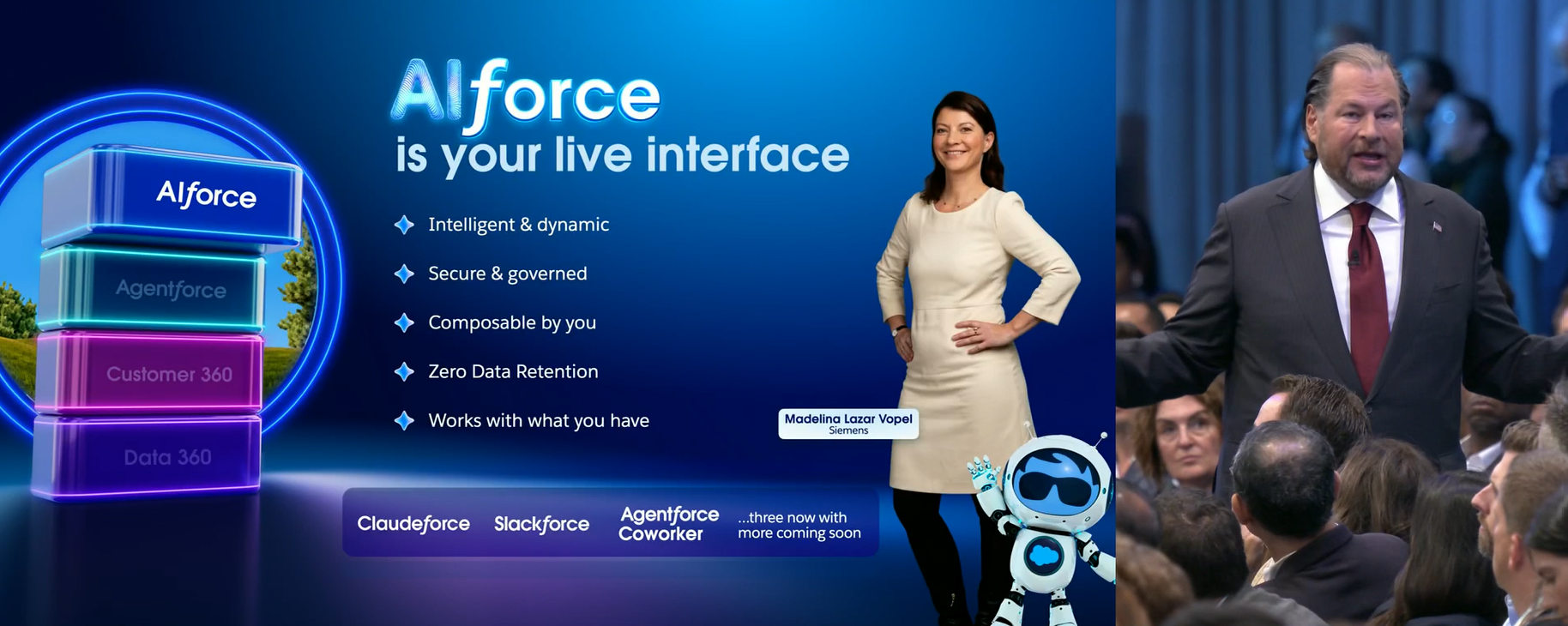
The centerpiece announcement was AIforce, described on stage as a live, dynamic interface that adapts to wherever people work. The logic behind it rests on a four-layer framework Salesforce has been building toward for years:
- Data: the foundation, unified and harmonized through Data 360.
- Apps & Semantics: the business logic and metadata that already live inside Customer 360.
- Agents: the digital workforce built on Agentforce.
- Interface: the new layer, AIforce, that brings it all together.
“Models alone can’t run the enterprise. AI models show what’s probable; core systems determine what’s allowed.”
On top of that framework sit four product pillars announced together for the first time: AIforce, Agentforce, Customer 360, and Data 360. The mapping is one-to-one: the Data layer is Data 360, Apps & Semantics is Customer 360, the Agents layer is Agentforce, and the Interface layer is AIforce. The keynote slides made each pillar’s job explicit: Customer 360 stands for “Apps, Semantics & Workflow Intelligence,” while Data 360 covers “Integration, Federation & Harmonization,” bringing together Informatica, MuleSoft, Agent Fabric, Tableau Knowledge, and the Metadata Platform under one roof.
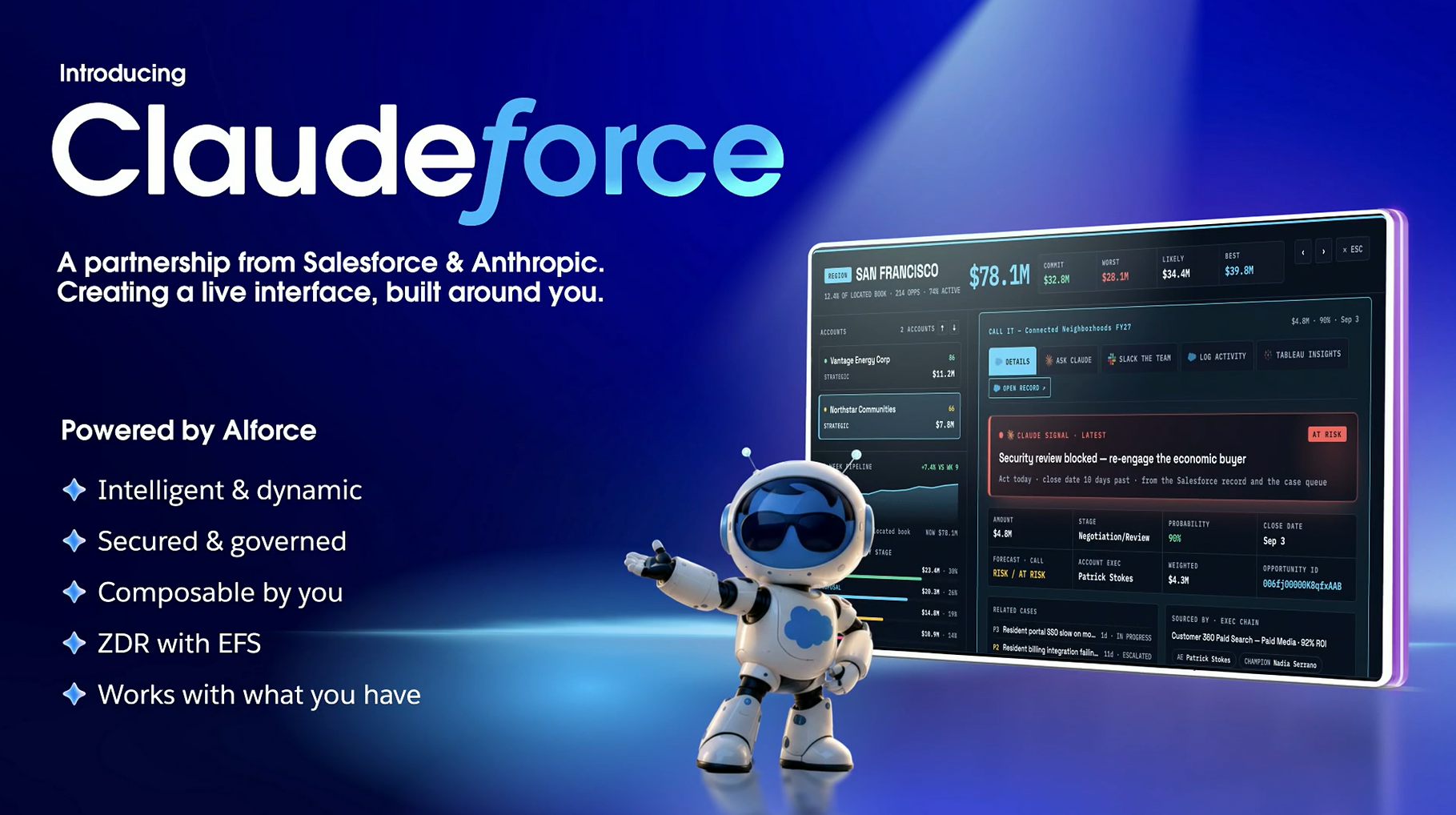
In practice, AIforce shows up differently depending on where you already work. Inside Claude Cowork, it takes the form of Claudeforce, part of the expanded Salesforce and Anthropic partnership. Inside Slack, it becomes Slackforce. Inside Lightning, it’s Agentforce Coworker. And for teams building their own experiences, the Live Interface layer also includes a Headless Toolkit, with more entry points “coming soon.” Same live interface, several doors in.
“Salesforce is powered by metadata. Metadata tells AI how your business works.”
Salesforce framed this as an interface revolution on the scale of the shifts from DOS to graphical interfaces, from desktop to web, and from web to mobile. Applications that have looked largely the same for years suddenly become dynamic, conversational, and built for the person using them.
Inside Claude Cowork: Meet Salesforce in Claude
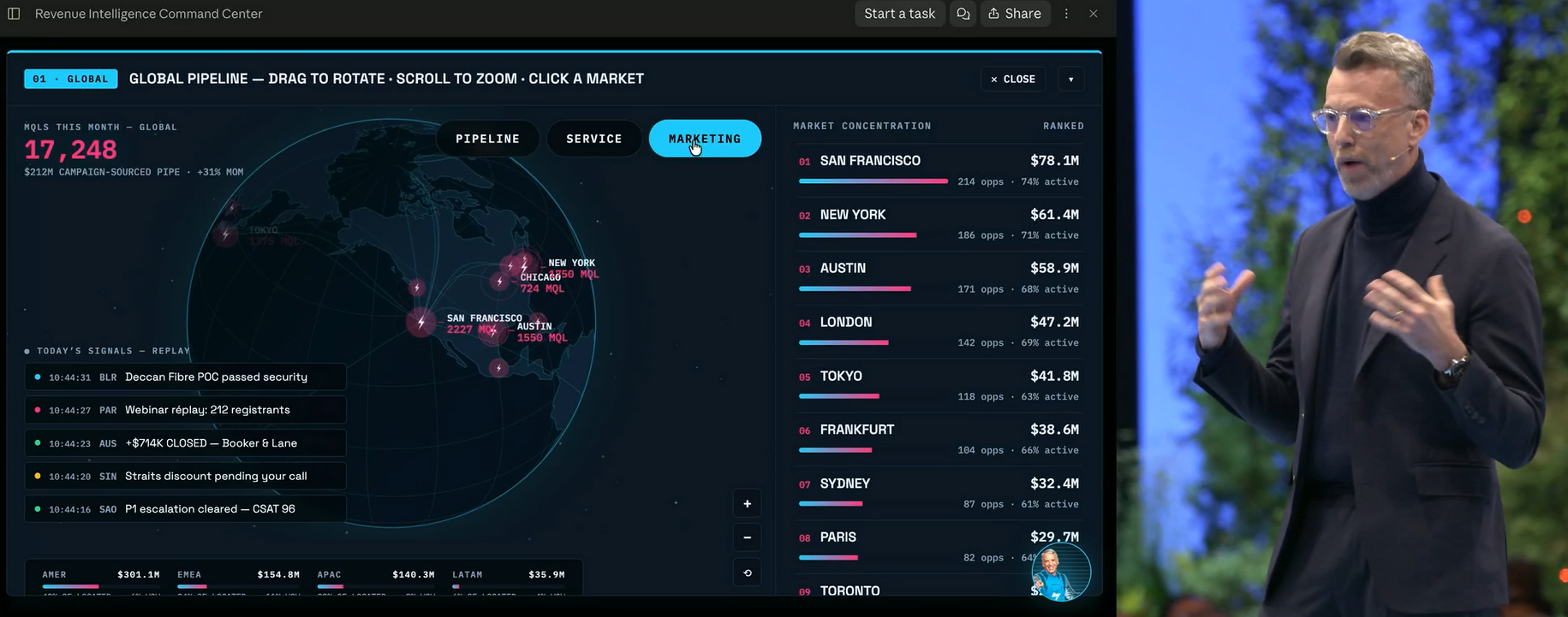
The clearest proof of how AIforce actually works came from a live demo. Patrick Stokes, Salesforce’s President of Applications and Marketing, built a fully custom command center inside Claude Cowork on stage; live pipeline data, service cases, and marketing activity, without a single engineer or product manager involved. He simply asked Claude for it.
That experience runs on a new plugin called Salesforce in Claude, part of the expanded Claudeforce partnership between Salesforce and Anthropic. The plugin packages three things that used to require serious technical lifting; MCP server setup, zero data retention configuration, and custom skill-building, into a single toggle any admin can turn on for chosen users.
“You get up and running on these interfaces in six to eight minutes,” Stokes said on stage, “and then you have a few days of back-and-forth as you iterate.”
Once connected, Claude can see live Salesforce data and act on it inside the same conversation: drafting a Slack message to the right team, logging an activity on an account, or surfacing which deals are most at risk this week, all governed by the same permissions and rules that already exist in Salesforce.
Agentforce Is Your Digital Workforce
Beyond the interface layer, Salesforce expanded its family of ready-to-deploy, out-of-the-box agents that any business user, not just IT, can implement. Availability varies by agent:
- Hunter, the outbound sales agent that hunts and qualifies leads, is now in pilot, with general availability planned for November 2026.
- Piper, the inbound pipeline generation agent, was demonstrated live and is already Generally Available, announced in the September 11 pre-Dreamforce wave.
- Casey, the help and service agent already live on Help, is now Generally Available.
- Paige, the ITSM and HR employee agent, is now Generally Available.
- Fin, the newly acquired customer service agent (formerly Intercom), is now Generally Available and part of Agentforce.
- Marshall, the supply chain and operations agent for back-office processes like supplier onboarding, was also demonstrated live and is Generally Available from the same September 11 wave. Its demo showed how agents can now execute directly inside backend systems, not just recommend actions.
- The keynote’s Digital Workforce also included Carter, a shopping agent, rounding out a roster that now covers the full front and back office.
The common thread across every demo was determinism: agents that don’t just improvise inside a probabilistic model, but learn a business process once and then execute it the same reliable way every time. For Cloudgaia’s clients, that maturity spread is actually good news: it means there is a sensible adoption path, starting with the GA agents that map to a clear bottleneck and piloting the rest as they harden.
Slackforce: AI Where Work Already Happens
Slack earned its own moment in the keynote, and for good reason: for many business users, Slackforce will be the first door into AIforce they walk through. Slackforce is simply AIforce living inside Slack; the same live interface, surfaced in the channels and conversations where work already happens.
Instead of asking teams to open yet another tool, Salesforce is bringing pipeline, cases, and customer context into the place where people are already talking about them. A seller can ask about deal risk in the same channel where the deal is being discussed; a support lead can pull case history without leaving the thread. Of all the doors into the live interface, this is the one with the least friction; AI that meets business users mid-conversation rather than waiting for them to come find it. For Cloudgaia’s clients that already run their day in Slack, this is where we expect the fastest adoption wins.
Real Value for Every Business
Rohan Kumar, Salesforce’s new President of Platform and Engineering, walked through why enterprise context, not raw model intelligence, is what makes AI genuinely useful for a business.
“Models are brilliant, but they don’t know your business. They need trusted context.”
The keynote laid out how that trusted context gets built and protected: Informatica gets enterprise data ready for AI, Data 360 turns it into trusted context, Tableau adds business semantics, Salesforce Guardian secures agent identity and data, and MuleSoft’s new Agent Fabric manages and governs every agent at scale, including agents from other providers.
This is the layer where most AI projects actually stall, not in choosing an agent, but in the unglamorous work of getting data ready to be trusted. It’s also where Cloudgaia spends most of its time with clients: mapping what lives in Informatica, deciding what belongs in Data 360, and making sure governance is in place before a single agent goes live. Get that foundation right, and every agent built on top of it gets stronger.
Trust Is Still the Product: Zero Data Retention
With a new interface layer built on large language models, the trust question was never far from the stage. Salesforce reiterated its zero data retention (ZDR) commitment: customer data is never used to train external models, a point Benioff repeated more than once. The keynote slides made the architecture explicit: “Salesforce Guardian with Zero Data Retention” sits as the foundation underneath all four layers of the stack, with Anthropic, AWS, Google, NVIDIA, and OpenAI named as partners on that trust boundary.
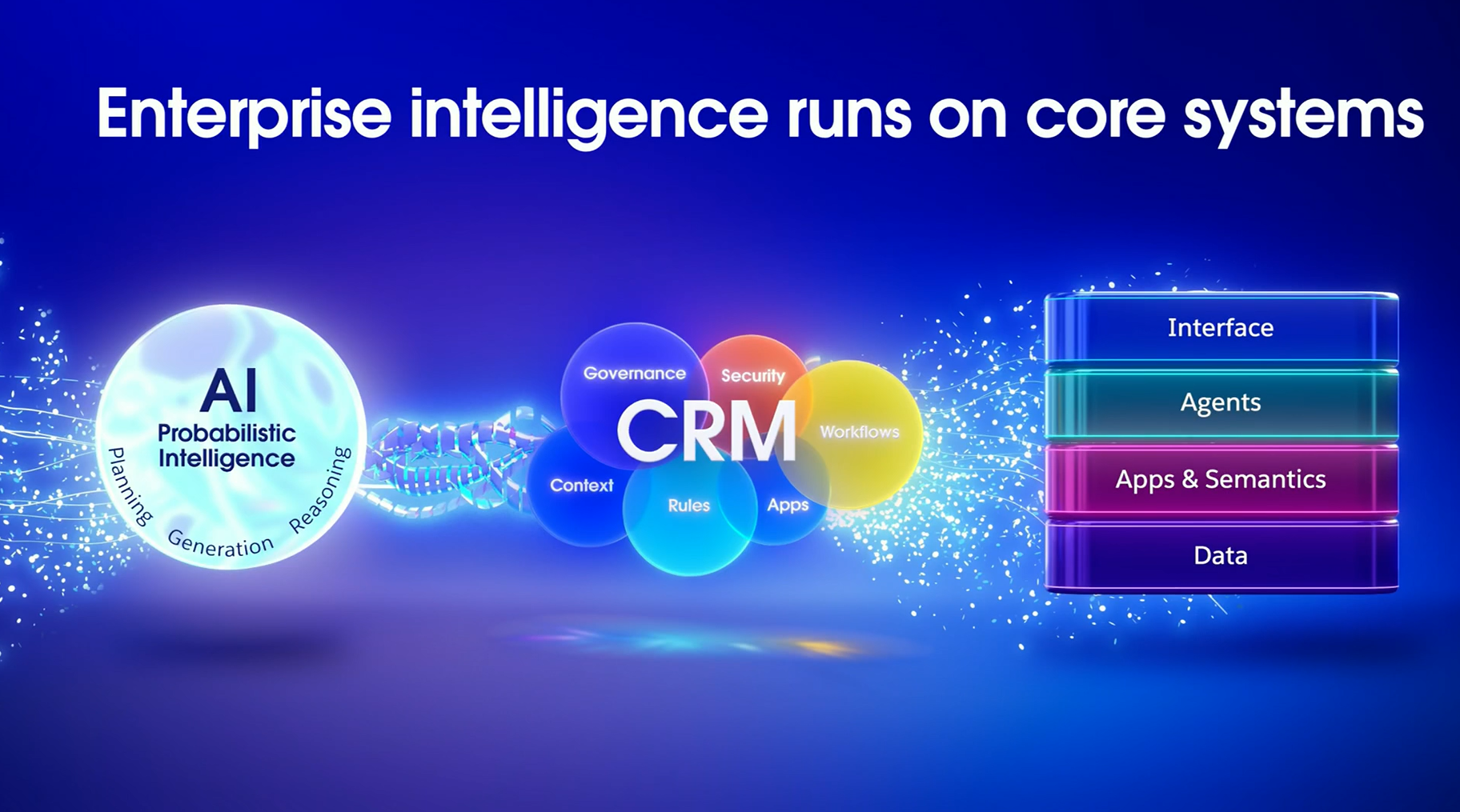
A second slide summed up the philosophy in one line: “Enterprise intelligence runs on core systems.” AI brings the probabilistic intelligence; the CRM and core systems bring the deterministic side, governance, security, rules, and context, that decides what actually happens.
The clearest expression of that commitment was the reveal of Koa, Salesforce’s first CRM reasoning model, purpose-built to power the Agentforce digital workforce. Koa is built on NVIDIA Nemotron and trained entirely on synthetic data, with not a single byte of customer data used in the process.
Every Company Can Become an Agentic Enterprise
Dreamforce 2026 confirmed what Cloudgaia has been telling clients all year: the technology is ready, and the real work now is turning it into results for your business. Whether you’re evaluating AIforce, planning your first Agentforce agents, or building a trusted data foundation with Data 360, our team can help you move from pilot to production.
Key Takeaways
- AIforce is Salesforce’s new live interface layer, appearing as Claudeforce, Slackforce, Agentforce Coworker, or a Headless Toolkit depending on where and how you work.
- The platform now rests on four pillars: AIforce, Agentforce, Customer 360, and Data 360.
- Zero data retention remains central to Salesforce’s trust story, with Salesforce Guardian as the foundation of the stack and Koa, a new CRM reasoning model trained only on synthetic data.
- Agentforce keeps expanding with ready-to-deploy agents at different maturity stages: Hunter (pilot, GA planned for November 2026); Casey, Paige, Fin, Piper, and Marshall (all Generally Available).
- Governance is catching up to scale, with Salesforce Guardian for security and Agent Fabric for managing agents from any provider.
- The real bottleneck for most businesses isn’t the technology. It’s adoption.
Q&A
What is AIforce?
AIforce is Salesforce’s new live, dynamic interface layer that adapts to wherever you already work, whether that’s Claude Cowork, Slack, or Lightning, unlocking value from your existing Salesforce data and metadata.
How is AIforce different from Agentforce?
Agentforce is Salesforce’s digital workforce, the agents that do the work. AIforce is the live interface layer that sits on top, connecting agents, data, and business context in one experience.
Is my data safe with these new AI capabilities?
Salesforce maintains its zero data retention commitment across these tools, meaning customer data is never used to train external models. Koa, the company’s new reasoning model, was trained entirely on synthetic data.
Where should my business start?
Most organizations start by getting their data ready for AI and mapping which agents, from outbound sales to service to operations, address their most pressing bottlenecks first.
Cloudgaia already works on both sides of this story: we implement Agentforce as part of our Salesforce practice. The models bring the intelligence and Salesforce brings the context and actions; Cloudgaia brings the process: implementation, adoption, and measurable value. If the keynote left you wondering where to start, that’s the conversation our team has every day.