
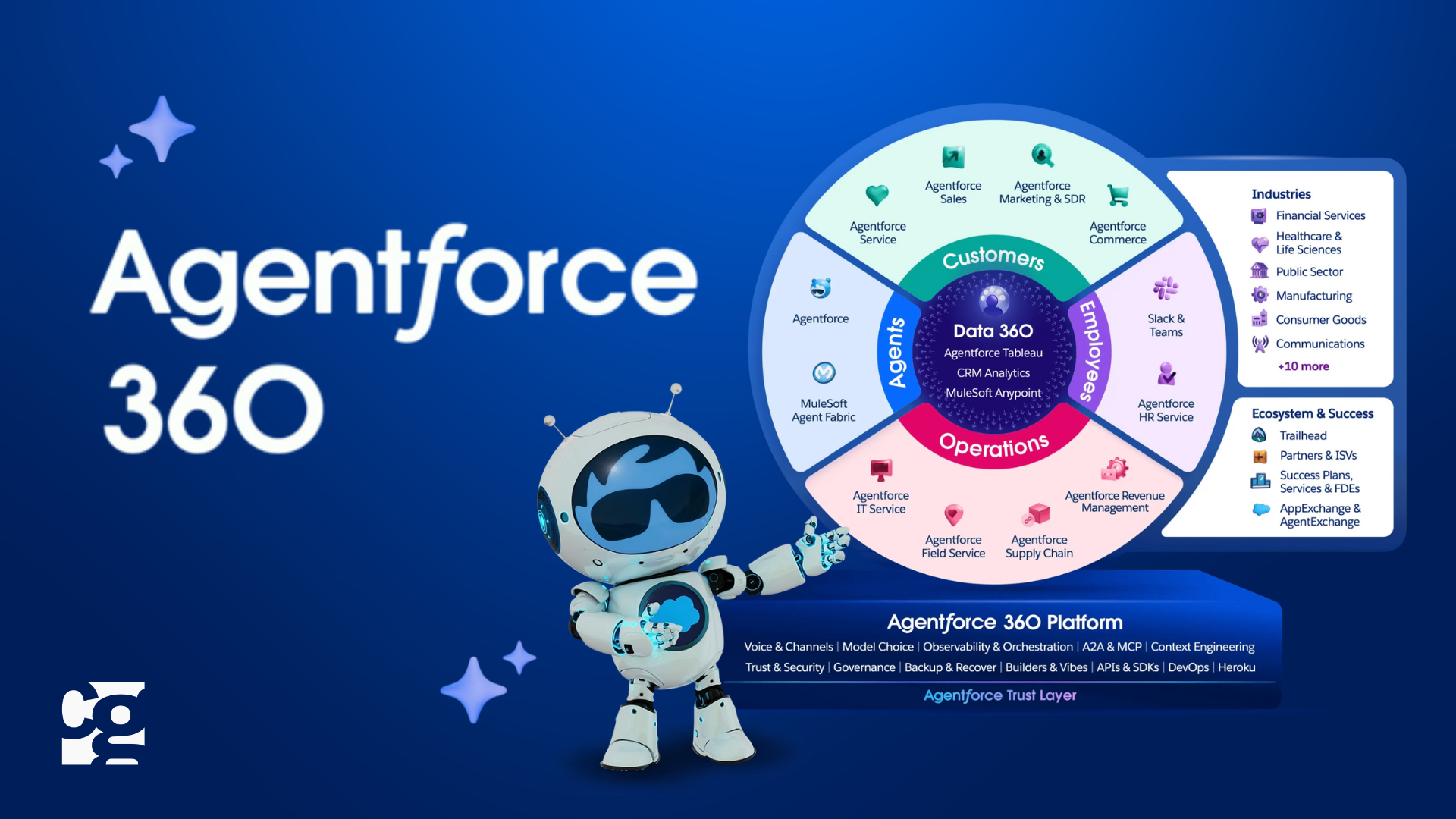
After just one year of Agentforce, Salesforce came back with something bigger and smarter. They listened, learned, and rebuilt their AI framework based on thousands of real use cases and lessons from the field.
That’s the foundation of Agentforce 360, Salesforce’s most advanced AI framework yet. It was designed around four essential pillars: Control, Context, Experience, and Manager — giving companies the structure to move from experimentation to reliable, scalable AI.
At Cloudgaia, we see this evolution as the next step toward the Agentic Enterprise, where humans and AI collaborate to drive measurable business results.
Agentforce Builder
Control: Simplicity That Scales
If last year was about experimentation, this one is about control.
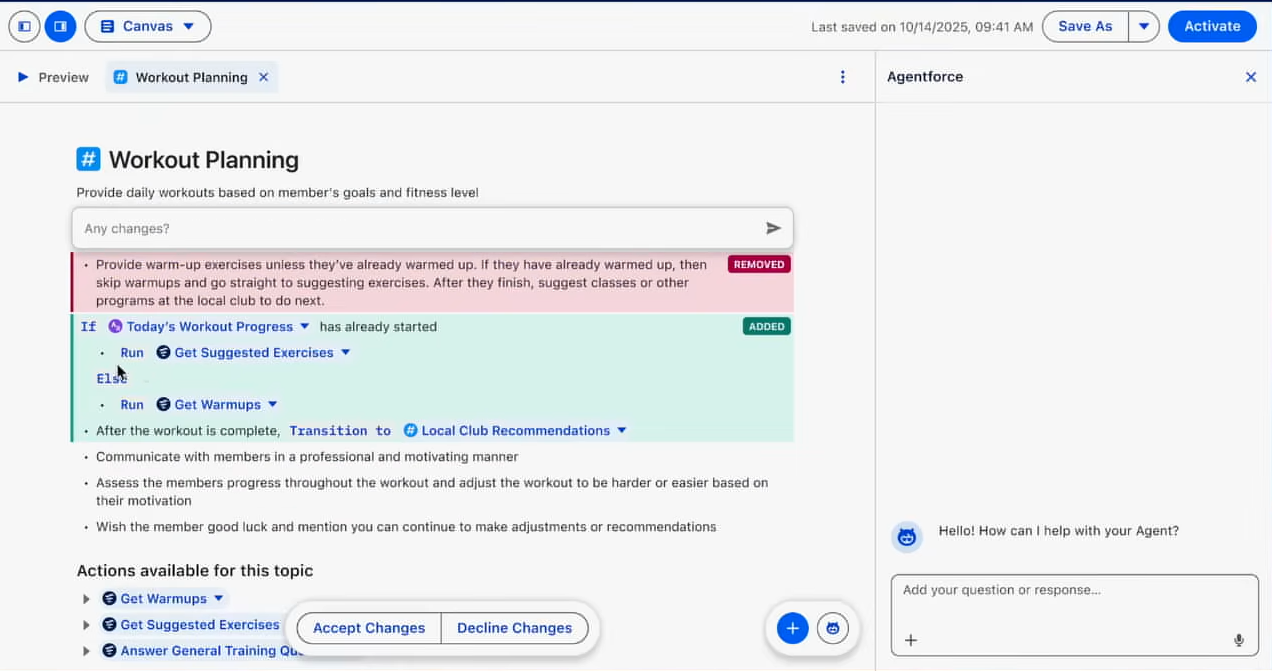
Salesforce completely reimagined how agents are built with the new Agentforce Builder, a clean, intuitive interface that makes AI creation accessible for everyone.
You can now describe what you need in plain language, and the system automatically generates the logic, variables, and rules behind the scenes. It’s AI building AI.
At the heart of this experience is AgentScript, a new scripting language that blends creativity with precision. Developers can edit every instruction directly, while non-technical teams collaborate visually in the same canvas.
In addition, one of Agentforce’s implementing clients mentioned the possibilities for customization: ”It’s just a process of training the agent to kind of, depending on the situation, but also, like, understanding the personality of the user and perhaps saying that Nancy requires a longer response whereas John might require a terser response, right?”
Agentforce 360 also embraces openness: agents can interconnect as sub-agents and even collaborate with third-party systems through MCP and A2A. The result? Smarter, adaptive networks of agents that scale effortlessly.
Context: From Content to Understanding
Data without context is noise. Salesforce addressed this challenge with Intelligent Context Processing, giving AI agents the ability to read, interpret, and reason with complex content — from PDFs and images to product manuals and workflows.
Agentforce 360 automatically analyzes and indexes documents, understanding visuals, layout, and data relationships. The system then recommends how to structure and apply this information consistently across the platform.
This means that when an agent responds, it can reference the exact source of its knowledge, making AI not just more accurate, but explainable, transparent, and compliant.
Agentforce Voice
Experience: Bringing Humanity Back to AI
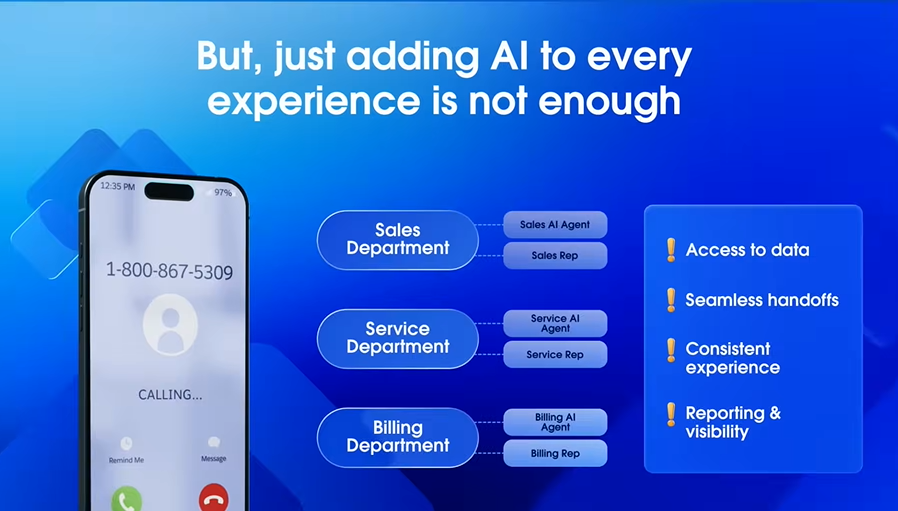
Customers today expect a unified, omnichannel experience, whether they’re chatting online, calling a support line, or visiting a store. Salesforce understands that consistency builds trust, and with Agentforce Voice, every interaction now speaks your brand’s language.
- Interruptible conversations: Agents can pause, listen, and adapt mid-conversation — just like a human would.
- Seamless human hand-off: When a chat transfers to a live agent, the full transcript and context move with it, ensuring a smooth, frustration-free experience.
- Brand-aligned personalities: Customize tone, voice, and behavior — whether your brand is friendly, premium, or playful, your agent reflects that identity.
- Omnichannel consistency: Keep the same tone, context, and accuracy across chat, voice, mobile apps, and service channels.
“First is that [the agent] Olive knew my nickname. How cool was that? Sanj, that’s me. And I promise I’m not that rude in real life, but I wanted to make sure I interrupted the agent as it was talking so you could get a feel for how this technology works. because we want it to be interruptible and to be very human-like in that way.”
- Sanjna Parulekar, SVP Product Marketing at Salesforce
Agentforce Grid
Manager: Visibility and scale
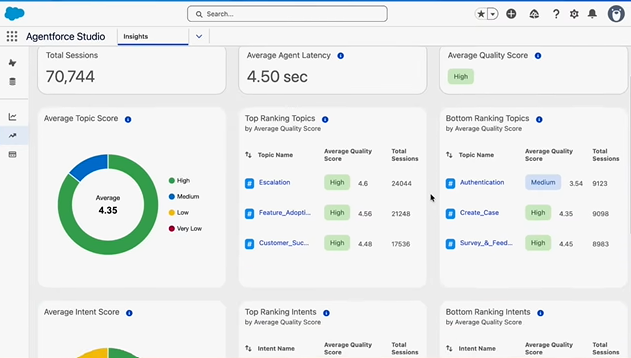
When you have dozens of digital agents working across departments — each solving cases, assisting customers, or automating workflows — you need visibility, control, and a way to measure success.
“They’re going to need tools to watch their agents, to make sure they’re measuring, monitoring, and optimizing all the performance of the agents they’ve deployedWe’re making agent managers’ lives easier by giving them visibility into performance”
- Leah McGowen-Hare, SV, Forward-Deployed Engineeering, Global Growth & Impact at Salesforce.
Salesforce introduced two essential tools to make this possible:
- Agentforce Observability – A centralized control center that gives full visibility into how agents perform, including live metrics, alerts, and behavior tracking. Teams can easily identify when an agent goes off-task and fine-tune its actions in real time.
Agentforce Grid – A new, spreadsheet-style interface where users can automate workflows, analyze outcomes, and iterate quickly, bringing AI management to the entire organization, not just technical teams.
Cloudgaia: Your Partner for Agentforce Transformation
With Cloudgaia’s expertise in Salesforce, AI, and digital transformation, we help clients:
- Deploy AI agents across sales, service, marketing, IT, and supply chain operations.
- Maximize human-agent collaboration for efficiency and strategic impact.
- Embed trust, context, and governance into every AI interaction.
- Scale AI solutions safely and effectively to achieve measurable results.
Agentforce 360 isn’t just an update, it’s Salesforce’s commitment to a new era of AIEnterprise that’s collaborative, transparent, and human.
At Cloudgaia, we’re ready to help companies take full advantage of these new capabilities.
Ready to scale your Salesforce AI strategy?