By Thiago Schmitz, Salesforce Enterprise Architect at Cloudgaia.
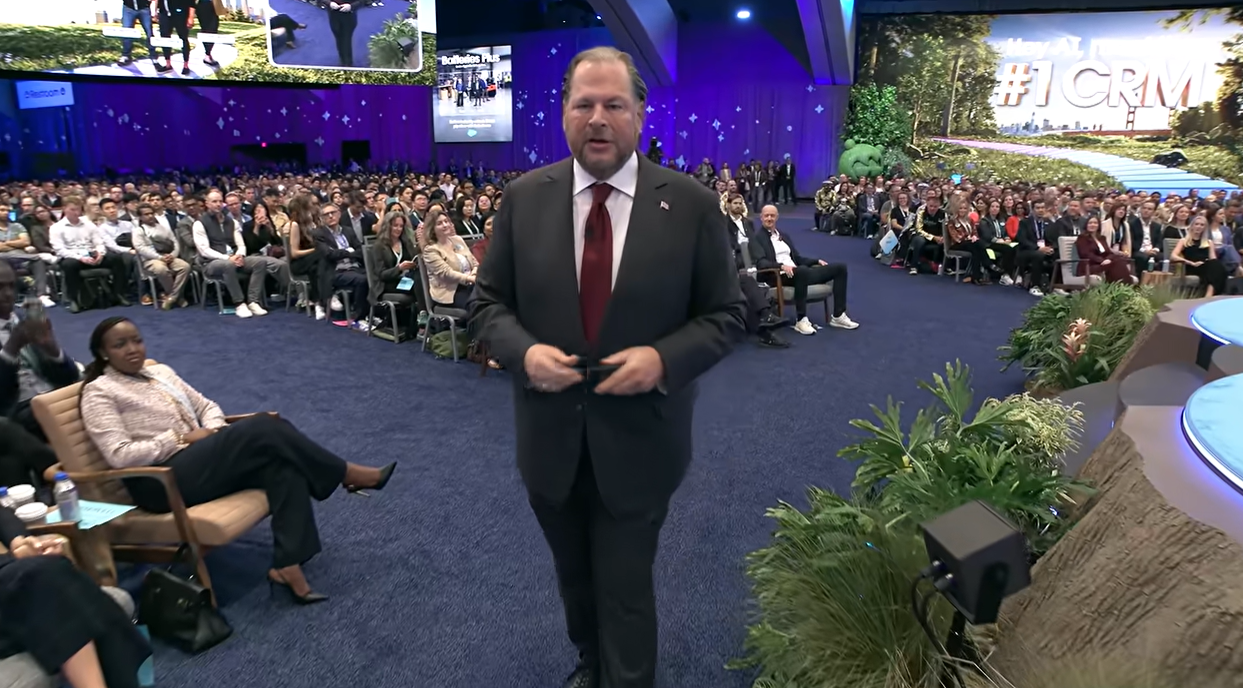
Dreamforce 2026 took place from September 15 to 17 in San Francisco, bringing together tens of thousands of in-person attendees and free livestreaming through Salesforce+. Those who followed remotely had access to the same keynotes and the same announcements as anyone who was at the Moscone Center.
The theme of the year, “Hey AI, Meet the #1 CRM,” sums up the moment well: Salesforce wants to move forward on agentic AI without giving up its identity as a CRM company. Practically, the entire agenda revolved around Agentforce, AIforce, Coworker, and agent architectures, but the real backdrop is different: AI is moving out of the stage-demo phase and into the production-architecture phase.
In this article, we bring together the themes that matter most for anyone who sells, provides support, does marketing, or operates within a specific industry using Salesforce, and we explain why each one deserves attention now.
AIforce: The New Interface Layer
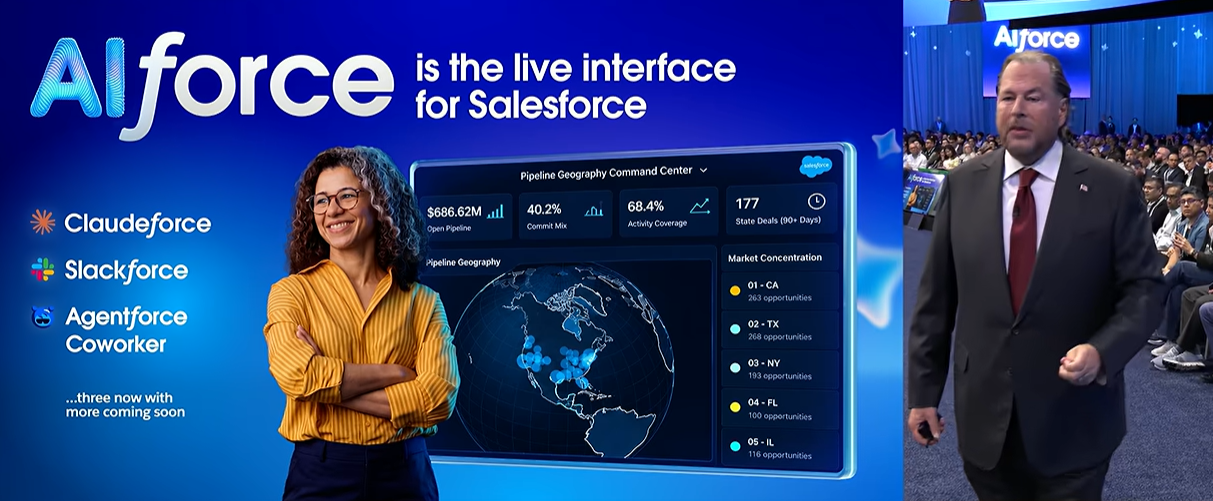
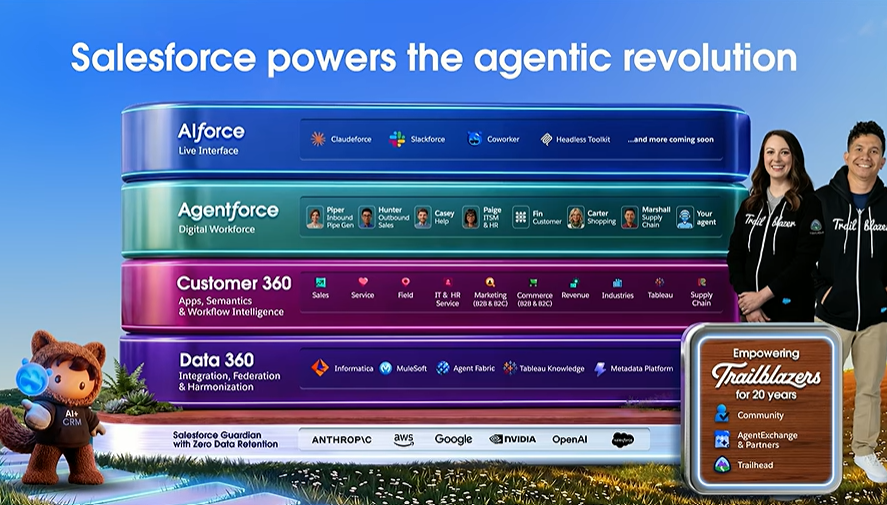
The central announcement of the opening keynote was AIforce, a living interface layer that connects Salesforce data, workflows, and permissions directly to tools like Claude, Slack, and other AI environments, without requiring the user to open the traditional CRM screen.
Alongside AIforce came Koa, the first reasoning model built specifically for CRM tasks, trained on the NVIDIA Nemotron foundation and already in pilot with customers such as Formula 1 and UChicago Medicine. Salesforce also expanded the range of models available within Agentforce, including Claude, Gemini, and models available via Amazon Bedrock.
The interface is no longer the Salesforce screen, it’s wherever the user already works. This changes how IT teams need to think about governance, permissions, and user experience, because sensitive data now flows through channels that used to sit outside the CRM’s scope.
Picture a salesperson asking Slack for the status of an opportunity and getting the answer with real Sales Cloud data, without opening the CRM. Or an employee resolving a request about time off directly through Teams, with the agent consulting Agentforce behind the scenes.
Cloudgaia helps design the permissions and data architecture needed for AIforce to work securely, and runs controlled pilots before expanding access to multiple teams.
Agentforce 360: From Proof of Concept to Production
For the first time since its launch, Agentforce was not the big news of the event, and that’s an important signal: the platform is moving from experimental to an established layer of the Salesforce ecosystem.
Salesforce introduced Agentforce Coworker, a portfolio of seven ready-to-use agents:
- Piper, for inbound lead qualification
- Hunter, for outbound prospecting
- Carter, for commerce experiences
- Casey and Fin, for service and customer experience
- Marshall, for supply chain and back-office orchestration
- Paige, for HR and IT requests
Multi-Agent Orchestration reached general availability, letting multiple agents collaborate with each other and hand off in real time, including by voice. On the governance side, the new MCP Risk Scores now automatically assess MCP servers registered with Agentforce, flagging risks such as prompt injection and tool poisoning before authorizing the connection.
The question that matters is no longer “do we have Agentforce?” but “which process actually benefits from real automation?” Buying technology without mapping the process remains the most common mistake at this stage.
A contact center can use Casey to resolve simple questions by voice, SMS, and WhatsApp, escalating to a human agent only when the case requires judgment. A sales team can use Hunter to qualify a cold list while human reps focus on strategic accounts.
Cloudgaia diagnoses processes before any agent implementation, defines where the human-plus-AI combination actually delivers a return, and designs the MCP and handoff governance needed to operate securely from day one.
Sales Cloud: The Salesperson with AI Built Into the Workflow
The commercial name went back to being Sales Cloud (the Agentforce Sales brand was discontinued), but AI remains built into the salesperson’s workflow. The new Piper and Hunter agents work directly within Sales Cloud, and one case shown at the event involved a global fintech using Agentforce and Data 360 to turn historical data into next-step recommendations for the sales team.
The difference between a CRM that logs activity and a CRM that guides the next action is the difference between hitting quota and missing it. AI built into the workflow cuts time spent on administrative tasks and increases time spent actually selling.
A B2B sales team with a long cycle can use an agent to automatically qualify leads from the website, prioritize accounts with the highest likelihood of closing based on history, and get next-step suggestions right on the opportunity screen.
Cloudgaia configures Sales Cloud and the sales agents on top of the customer’s real data model, connecting CRM, ERP, and external sources via Data 360 so recommendations are trustworthy from day one of use.
Service Cloud: Voice, Coworker, and Agentic Support
Service Cloud, also back to its original name, got reinforcement in voice support. Agentforce Voice has already resolved more than five million conversations on Salesforce’s own support site alone, and the architecture shown at the event treats voice as part of a complete agentic support experience, not just another isolated channel.
One example shown was Adecco’s recruiting agent, which resolves a certification pending item during the call itself: it verifies the data and updates the application in real time. Salesforce also demonstrated real-time handoff between a third-party agent, running on Amazon Connect, and an Agentforce agent, letting the conversation continue without the customer having to repeat information.
Service leaders should measure automation by actual resolution capability, not just containment rate. An agent that reduces response time but doesn’t solve the problem just pushes the customer’s frustration further down the line.
A health plan replaced multiple disconnected systems with a single foundation on Health Cloud, unifying member data, automating documentation, and laying the groundwork for Agentforce-assisted service.
Cloudgaia designs the escalation flow between AI and human support, defines the right success metrics beyond containment, and makes sure the knowledge base and data are ready before any agent goes into production.
Marketing Cloud Next: Campaigns Built by Agents
The big change in marketing for 2026 is Marketing Cloud Next, a complete rebuild of the platform on the Salesforce core and Data 360, eliminating the old need for connectors between marketing data and CRM data. A new Campaign Agent, with general availability expected in October 2026 on the Advanced edition, creates campaigns autonomously from a briefing. The commercial brand went back to being presented as an evolution of Marketing Cloud, no longer as Agentforce Marketing.
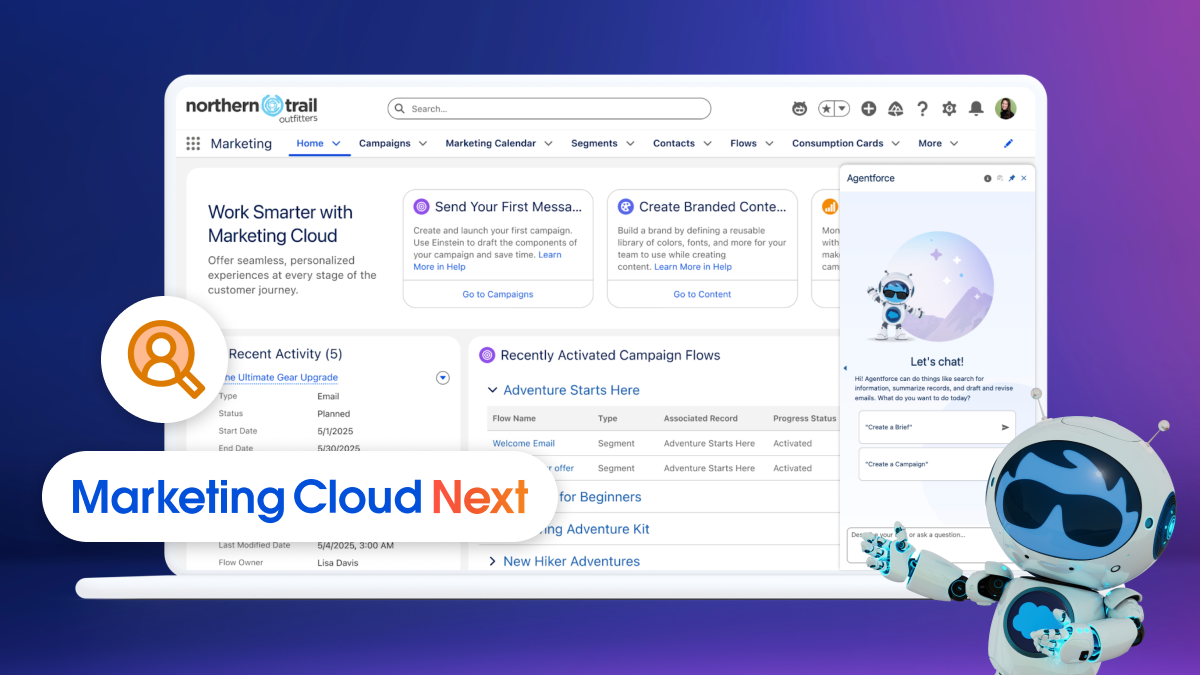
The real gain isn’t “one more agent,” it’s the end of the lag between customer behavior data and campaign action. Data and execution living on the same platform reduce integration rework and speed up real-time personalization.
A retail brand could launch a seasonal restocking campaign in which the campaign agent uses browsing signals and purchase history from Data 360 to build segmentation, copy, and channels automatically, leaving final review to the human team.
Cloudgaia migrates legacy marketing environments to Marketing Cloud Next without losing customer journey history, and configures campaign agents to respect each industry’s brand and compliance rules.
Industries in Focus: Six Sectors, Six Different Strategies
The industries agenda reinforced a central point: an agentic strategy isn’t generic, it changes depending on the sector.
- Consumer goods: Agentforce Consumer Goods (formerly Consumer Goods Cloud) unifies planning and execution in a sector-specific data model, helping field teams improve trade promotion effectiveness and pursue the “perfect store.”
- Financial services: Financial Services Cloud bets on proactive customer engagement with AI-driven experiences, balancing speed with the governance required in regulated sectors.
- Manufacturing: Manufacturing Cloud integrates data across the value chain to improve service to customers and channel partners.
- Healthcare: Health and Life Sciences Cloud shows up in cases like a health plan that unified member data and is moving toward Agentforce-assisted service.
- Automotive: Agentforce Automotive already powers next-generation CRMs for dealerships, bringing manufacturers, dealers, and buyers together on a single platform.
- Retail: Retail Cloud delivers unified, real-time data to speed up customer acquisition and profitability.
Applying a generic agent to a regulated process or one with high operational complexity, without adapting the data model to the sector, is the most common way to turn a promising project into a shelved one.
A dealership network can replace a generic automotive CRM with a solution built on Agentforce Automotive, unifying the funnel from lead to after-sales. A consumer goods company can use the sector-specific data model to reduce stockouts at the point of sale.
Cloudgaia has a dedicated practice across these six sectors, adapting Salesforce’s industry data model to each client’s regulatory and operational reality, from designing data governance to implementing the sector-specific agents.
What to Do With All of This
Dreamforce 2026 made it clear that agentic AI is moving from stage demo to production architecture, with governance, models, and industry-specific agents all maturing at the same time.
Executing well, however, still requires mapping processes before choosing technology, adapting the data model to the sector, and measuring business outcomes, not just adoption. That’s exactly where a partner with deep Salesforce expertise and governance discipline makes the difference between an interesting pilot and an AI program that sustains growth.
If you want to understand which of these announcements is actually worth prioritizing for your operation, we’d be glad to talk.
Key Takeaways
- AIforce creates a new interface layer that brings Salesforce data and workflows to Claude, Slack, and other AI tools.
- Koa is Salesforce’s first reasoning model dedicated to CRM tasks, still in an early adoption phase.
- Agentforce 360 expands the portfolio of ready-to-use agents for sales, service, marketing, and back-office operations.
- Marketing Cloud Next unifies marketing and CRM data on the same platform, eliminating legacy connectors.
- Every sector, consumer goods, financial services, manufacturing, healthcare, automotive, and retail, requires its own data model and agent strategy.
- Governance and MCP Risk Scores have become central to agentic architecture, not an afterthought.
Questions Organizations Should Ask
Does AIforce replace Agentforce?
No. AIforce is the interface layer that connects data and permissions to external tools. Agentforce remains the agent layer that executes the actions.
Does Marketing Cloud Next require a full migration to work?
In most cases, yes, to capture the benefit of unified data with Data 360. But the migration can be done in stages, starting with the highest-return use cases.
My industry doesn’t have a dedicated Salesforce cloud. Does that mean agentic AI doesn’t apply?
No. The principles of process-driven automation, unified data, and governance apply to any sector. What changes is how much the data model needs to be customized.
About the Author