
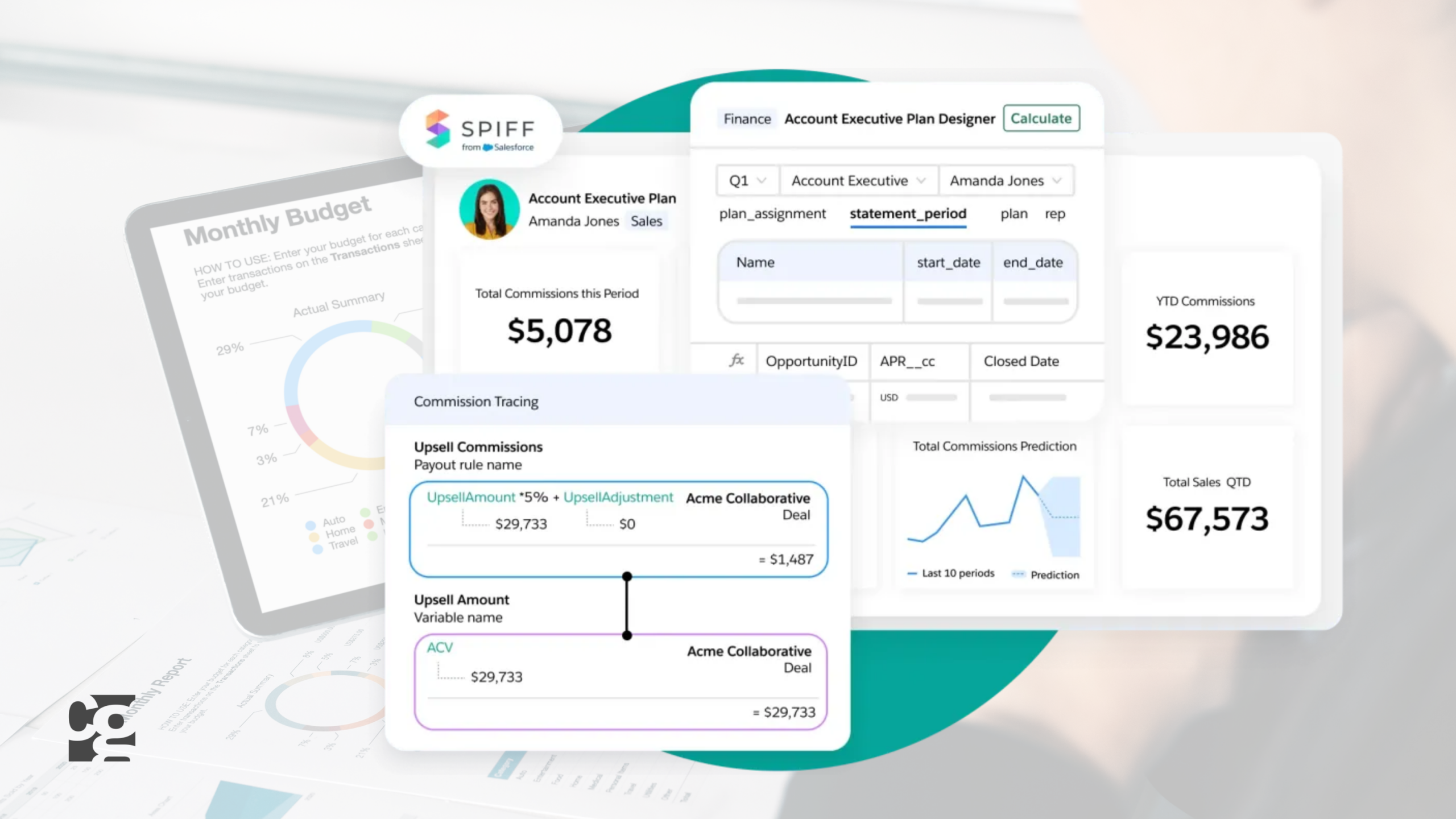
Automating commission calculations, improving transparency, and eliminating spreadsheet chaos
By Francisco Harte, Francisco Martinez, and Thiago Schmitz
Table of Contents
- What Is Salesforce Spiff?
- A Real World Use Case: Commissioning Closed Won Opportunities
- Seeing Expected Earnings Directly in Salesforce
- From the Rep Dashboard: Payout Plans and Expected Earnings
- Bringing It All Together
- Key Takeaways
- Questions Organizations Should Be Asking
If you run Sales Operations, Revenue Operations, or Finance, you probably know the end-of-month routine.
Sales reps ask where their commission is.
Finance teams reconcile spreadsheets.
Someone discovers a formula error just before payroll is processed.
Commission management is one of those processes that seems straightforward until it becomes operationally complex.
That is exactly the problem Salesforce Spiff was designed to solve.
What Is Salesforce Spiff?
Spiff is Salesforce’s Incentive Compensation Management (ICM) solution.
It automates commission calculations by connecting directly to Salesforce and other systems such as ERP, HCM, and payroll platforms, then applying compensation plan rules in real time.
Instead of manually maintaining commission spreadsheets every pay period, organizations can use Spiff’s rules engine to automatically calculate earnings, even when plans include:
- Multiple commission tiers
- Accelerators
- Bonus thresholds
- Complex payout conditions
- Mid-period plan changes
Because every adjustment is tracked through an audit trail, compensation plans remain transparent and compliant.
Equally important, Spiff provides real-time visibility for both sales representatives and managers.
Reps can see exactly what they have earned and why.
Finance teams gain automated reporting and audit readiness.
The result is greater trust, fewer disputes, and significantly less administrative effort.
A Real World Use Case: Commissioning Closed Won Opportunities
Let’s look at a common B2B scenario.
A company wants to reward sales representatives for successfully closing opportunities that included a completed customer visit.
The compensation rule is simple:
Eligibility
- Opportunity must be Closed Won
- Opportunity must have at least one related Visit with a status of Completed
Earnings
- $20 per qualifying Opportunity
- Additional $100 bonus if the rep closes more than five qualifying Opportunities during the month
Within Salesforce, the sales representative simply closes the Opportunity and logs the completed Visit.
From there, Spiff automatically:
- Retrieves Opportunity data
- Verifies Visit completion
- Applies eligibility rules
- Calculates earnings
- Tracks bonus thresholds
No manual spreadsheets.
No side calculations.
No waiting until month end to determine whether the deal qualifies.
This example highlights why Spiff’s rules engine is so valuable.
Eligibility is not based on a single condition. It requires validation across related records plus period-based bonus calculations.
Managing that process manually is where errors typically occur.
Automation eliminates that risk.
Seeing Expected Earnings Directly in Salesforce
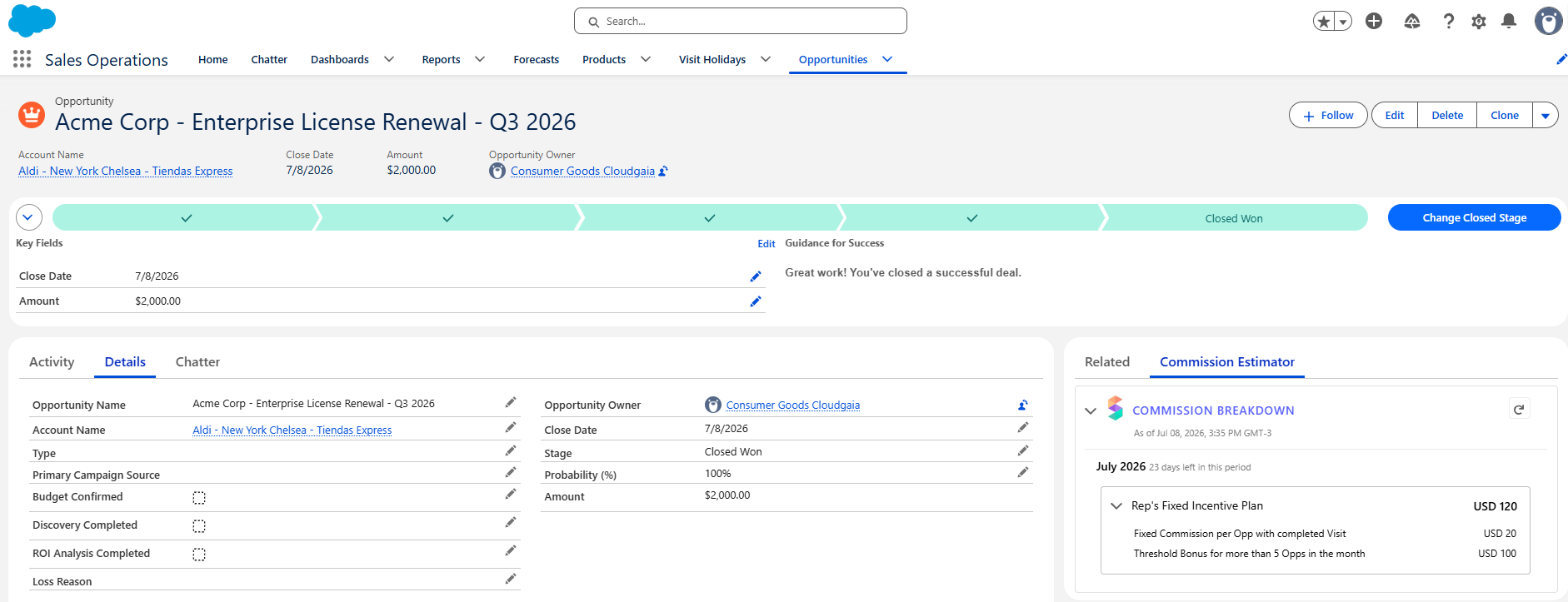
One of Spiff’s most practical capabilities is the Commission Breakdown Component, which can be embedded directly within the Salesforce Opportunity page.
This allows sales representatives and managers to see commission information without leaving Salesforce.
The component displays:
- Expected earnings for the Opportunity
- Applicable payout plans
- Specific payout rules triggered by the deal
- Bonus eligibility details
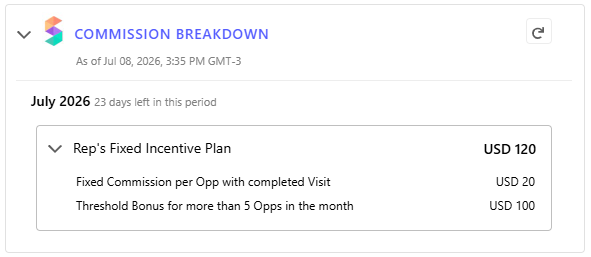
For example, if an Opportunity qualifies under the “Completed Visit” commission rule, the component clearly shows the commission associated with that rule.
This creates a direct connection between the compensation plan configured in Spiff and what users see on the Opportunity record.
There is no guesswork.
There is no disconnect between compensation logic and operational execution.
For sales leaders, this seemingly small feature delivers significant value by making commission visibility part of the daily workflow.
From the Rep Dashboard: Payout Plans and Expected Earnings
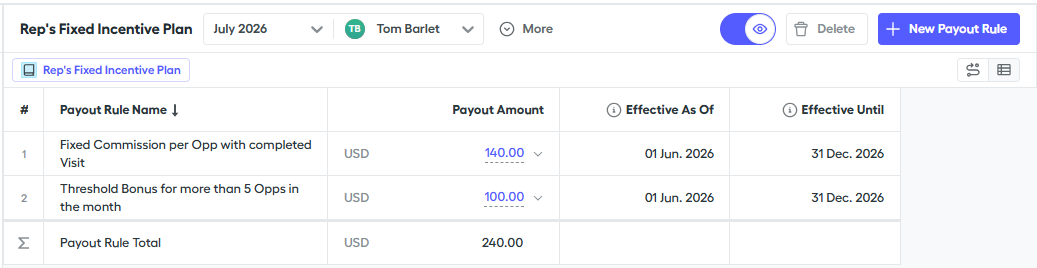
Beyond Salesforce record pages, Spiff provides a dedicated dashboard where sales representatives can track performance against compensation plans.
The dashboard provides:
- Active payout plans
- Progress toward incentive thresholds
- Expected earnings
- Performance metrics
- Detailed earning calculations
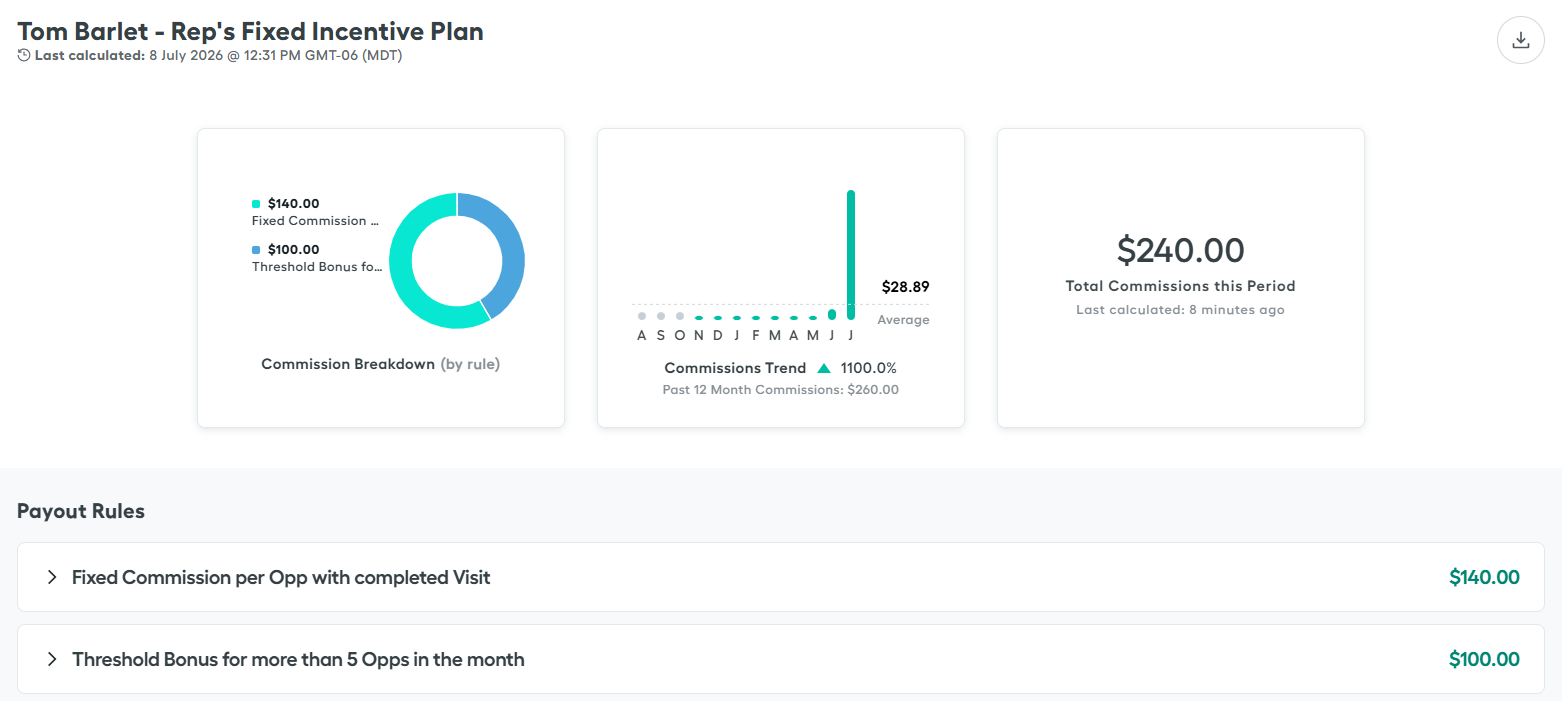
This is where transparency becomes a competitive advantage.
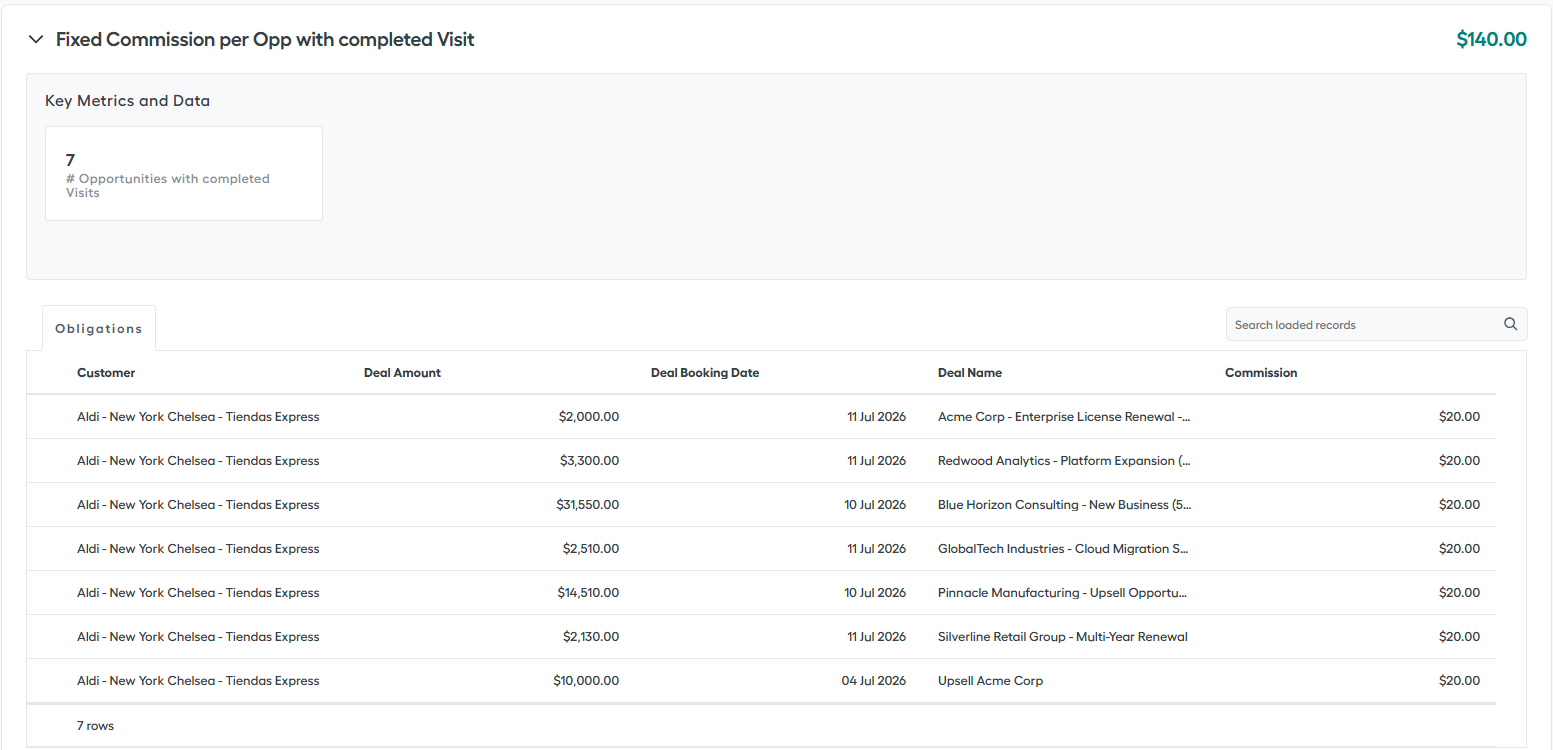
Rather than questioning why a commission payment looks different than expected, reps can review the exact calculations that generated it.
Every dollar can be traced back to:
- A qualifying Opportunity
- A specific payout rule
- A documented compensation plan
This level of visibility significantly reduces commission disputes and builds confidence in the compensation process.
For RevOps, Sales Operations, and Finance teams, that means fewer support requests and more time focused on coaching, forecasting, and revenue growth.
Bringing It All Together
Commission management does not have to become a monthly fire drill.
Salesforce Spiff automates the calculation process using data already stored within Salesforce, while providing real-time transparency to sales representatives, managers, and finance teams.
The result is:
- Fewer spreadsheet errors
- Faster commission processing
- Reduced payroll risk
- Improved trust in compensation plans
- Faster onboarding for new sales representatives
- Greater operational efficiency
As compensation plans become more sophisticated, Spiff scales with them.
Organizations can continue evolving incentive programs without increasing administrative complexity.
If your team is still managing commissions in spreadsheets, or if sales representatives regularly question how commissions are calculated, it may be time to evaluate a more scalable approach.
At Cloudgaia, we help organizations design, implement, and optimize Salesforce Spiff so compensation management becomes accurate, transparent, and easy to maintain.
Key Takeaways
|
Questions Organizations Should Be Asking
Why do commission processes become difficult to manage as sales teams grow?
As compensation plans evolve, manual spreadsheets become harder to maintain and more prone to errors. Multiple payout rules, accelerators, and bonus thresholds increase complexity exponentially.
Can Spiff handle compensation plans with multiple conditions?
Yes. Spiff supports complex eligibility criteria across multiple Salesforce objects, time periods, payout tiers, accelerators, and bonus structures.
Do sales representatives need to leave Salesforce to see their commissions?
No. The Commission Breakdown component can be embedded directly into Salesforce record pages, allowing users to view earnings without switching systems.
How does Spiff improve trust in compensation plans?
By providing real-time visibility into earnings calculations and allowing users to trace payouts back to specific opportunities and payout rules.
Who benefits most from implementing Spiff?
Sales Operations, Revenue Operations, Finance teams, Sales Managers, and Sales Representatives all benefit through improved transparency, reduced administrative effort, and more accurate commission management.
About the Authors
Francisco Harte
Salesforce specialist focused on helping organizations improve sales operations, process automation, and revenue performance through scalable Salesforce solutions.
Francisco Martinez
Salesforce consultant with experience designing and implementing business processes that improve operational efficiency, visibility, and performance measurement.
Thiago Schmitz
Enterprise Architect for Salesforce Core at Cloudgaia. Thiago specializes in Salesforce architecture, data strategy, and enterprise transformation initiatives that connect business objectives with scalable technology solutions.