
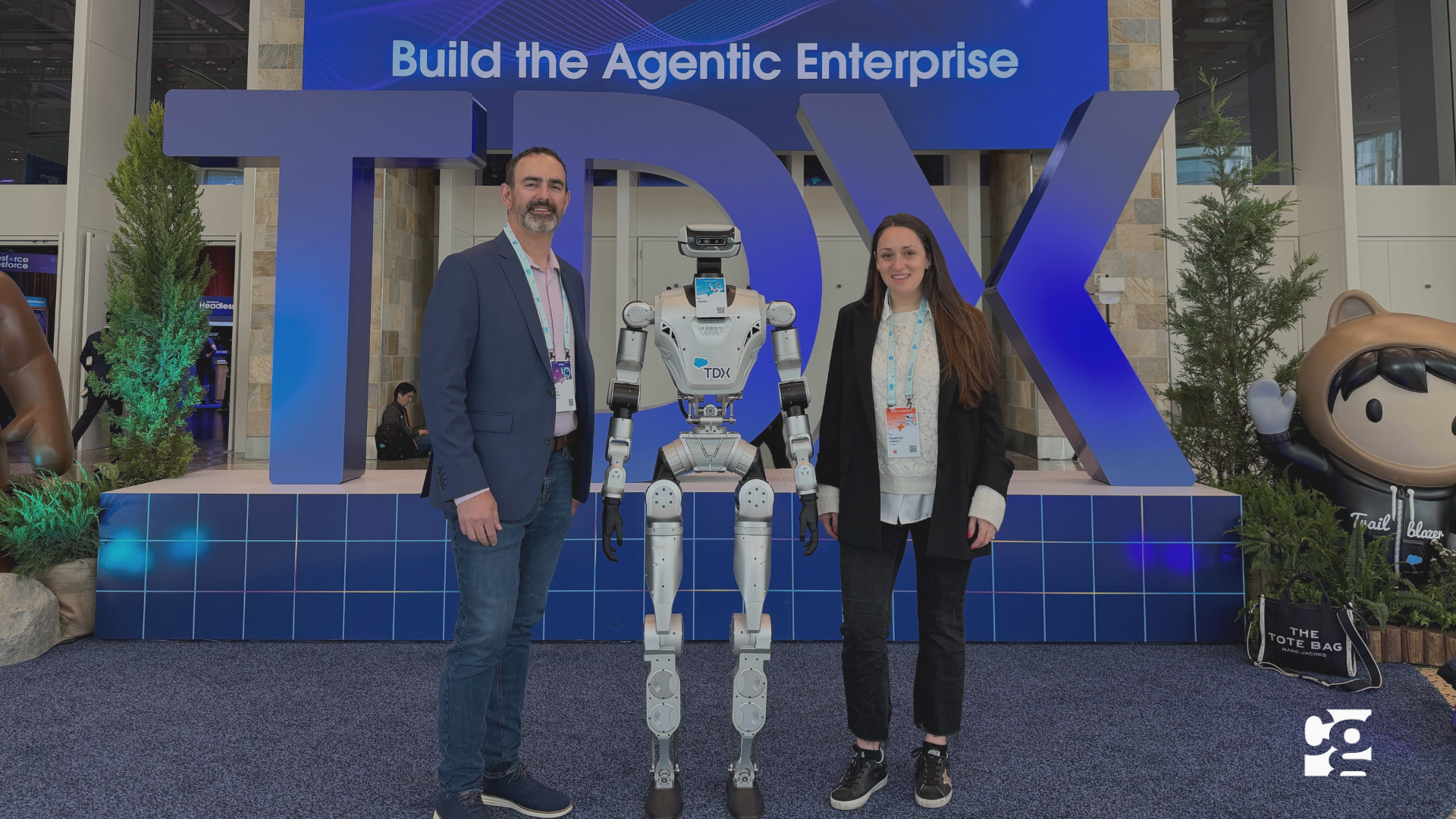
By Florencia Cattelani, Managing Director EU, MuleSoft Ambassador at Cloudgaia.
Table of Contents
- Salesforce Is Now Consumable by Anyone, Through MCP
- APIs Are the New UI and That Should Make You Rethink UX
- MuleSoft People: You Have Already Seen This Movie
- Deterministic vs Probabilistic: The Hardest Shift
- The Agentic Lifecycle Has Been Redesigned
- Agentforce Vibes 2.0: What You Need to Know
- AgentExchange and the $50M Bet on the Ecosystem
- Agentforce Labs: Finally, a Place to See What’s Coming
- React on Salesforce: What It Means for the UI Conversation
- What I Am Taking Back From TDX 2026 Salesforce
- Key Takeaways
- Conclusion
- Frequently Asked Questions (FAQ)
Just got back from San Francisco and I’m still processing what happened at TDX 2026 Salesforce. Not because of the announcements themselves (though there were plenty), but because of the mental model shift underneath all of them.
Here are the things I can’t stop thinking about after TDX 2026 Salesforce.
Salesforce Is Now Consumable by Anyone, Through MCP
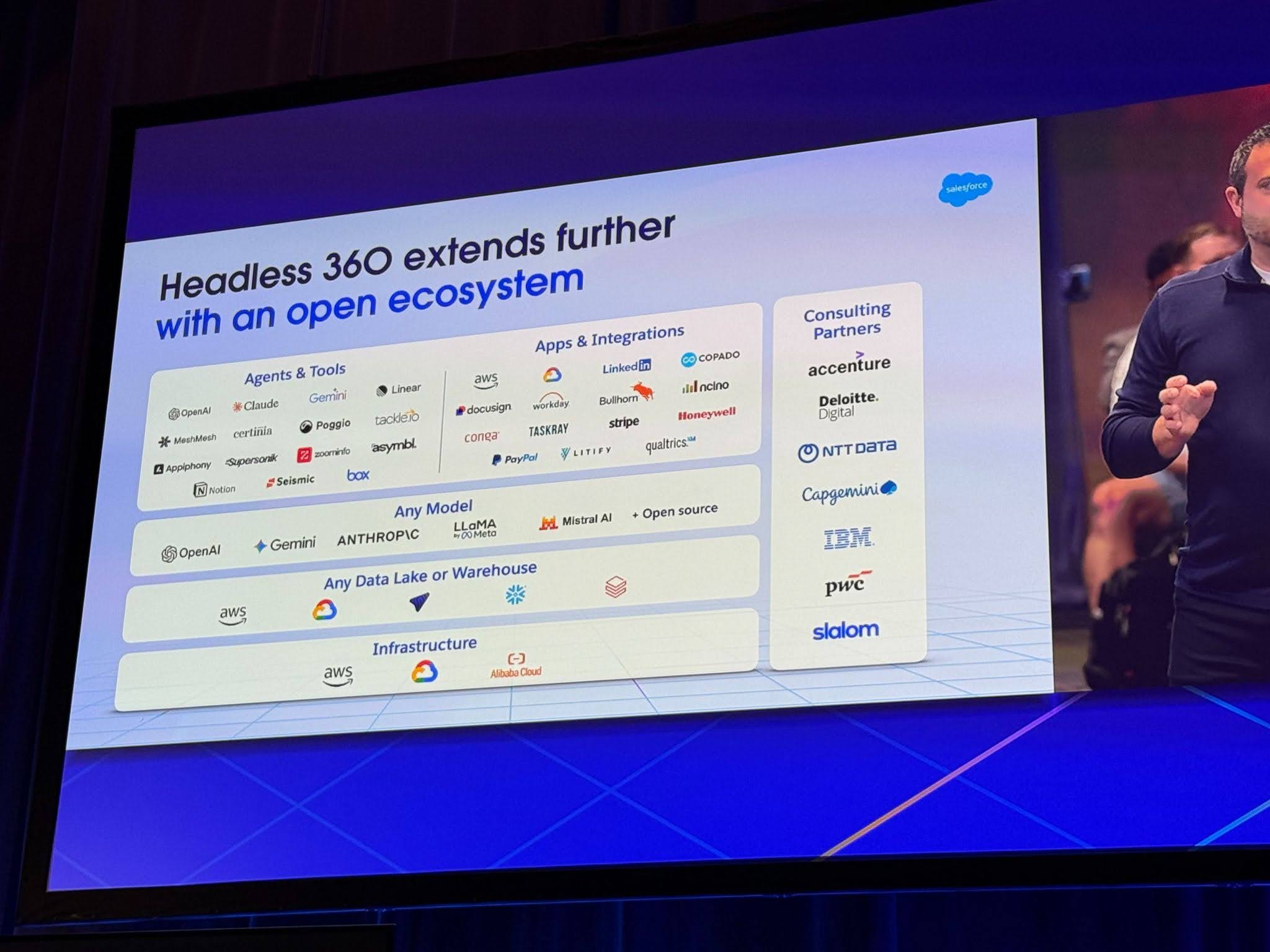
The biggest structural move at TDX 2026 Salesforce wasn’t a single product. It was the direction: Salesforce Headless 360, with 60+ MCP tools generally available right now.
MCP (Model Context Protocol) means any AI agent, from any vendor, can now call into Salesforce capabilities directly. Not through a custom integration. Not through a Salesforce native UI. Through a standard protocol that any LLM powered system can speak.
Think about what this means. For years, “Salesforce integration” meant building connectors, middleware, or ETL pipelines. Now, the question becomes what your AI agent needs to do and which MCP tools it calls.
This is a fundamental reframe of what the Salesforce platform is. It is no longer a suite of UIs backed by a database. It is a capability layer that any intelligent system can consume.
APIs Are the New UI and That Should Make You Rethink UX
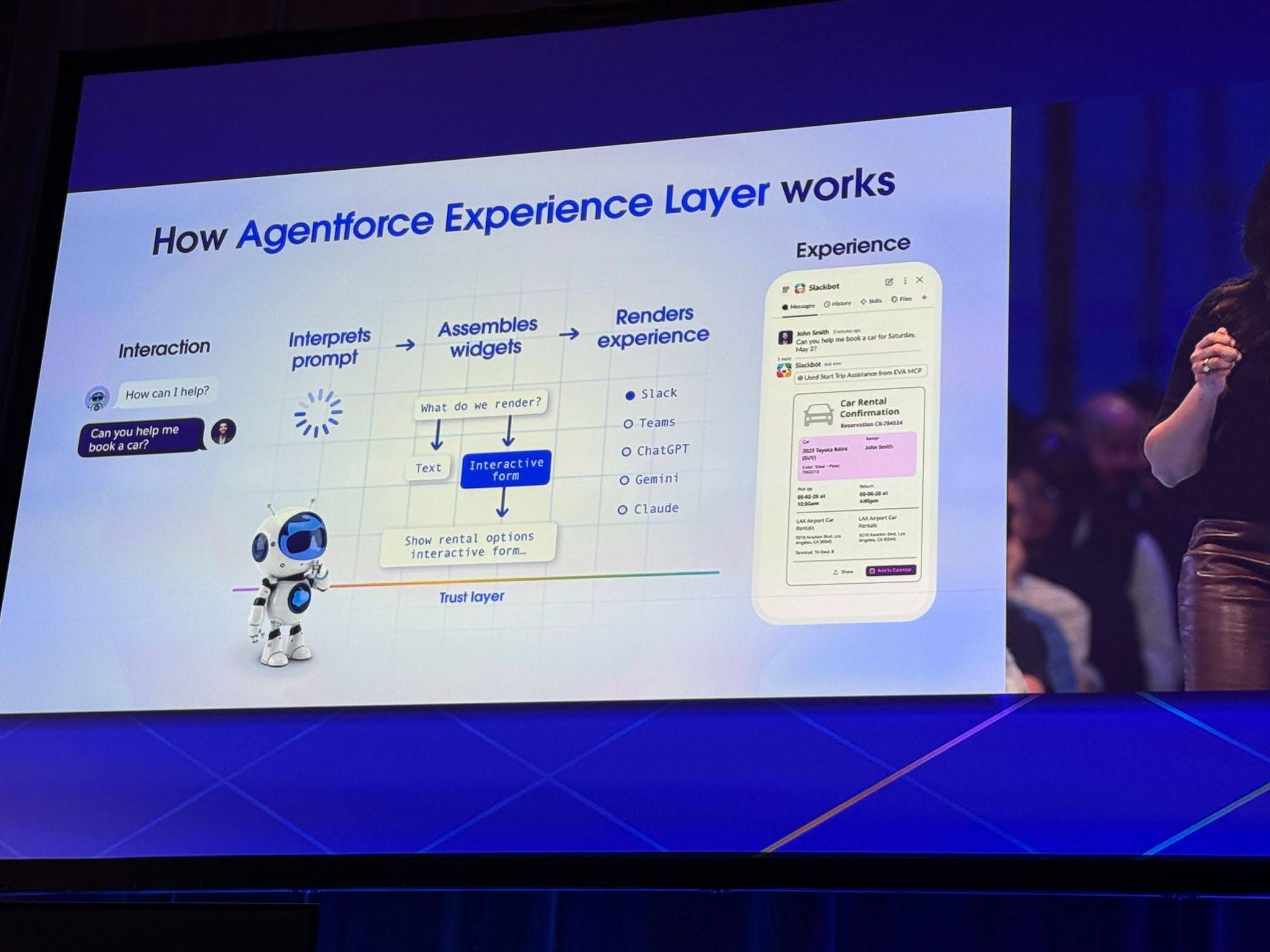
Here is the slide from TDX 2026 Salesforce that stayed with me the most: Agentforce Experience Layer (Beta July ’26).
The idea is that an agent interprets a user’s intent, assembles the right widgets, and renders an experience across Slack, Teams, ChatGPT, Gemini, Claude, or any other surface. The same underlying agent, many different front ends.
| For years we have been saying that the API is the product. Turns out we were more right than we knew. |
If an agent now decides what UI to render, based on context and intent, then the traditional notion of UI/UX design is being fundamentally disrupted. You are no longer designing screens. You are designing interaction contracts. The experience is assembled dynamically, not authored statically.
This does not make UX irrelevant. It makes it more important and more abstract at the same time. The craft moves from pixel pushing to designing the vocabulary of components that agents can compose. From wireframes to widget libraries. From user flows to intent taxonomies.
I do not think the industry has fully processed this yet.
MuleSoft People: You Have Already Seen This Movie
When I saw the Agentforce Experience Layer at TDX 2026 Salesforce, my MuleSoft brain lit up immediately.
The three layer API model (System, Process, Experience) was always about one thing, which is separating the channel from the capability. Your system APIs expose the data. Your process APIs orchestrate the logic. Your experience APIs shape the output for a specific consumer.
What the Experience Layer does is exactly that, except now the “consumer” is a conversational channel, and the “shaping” is done dynamically by an AI. The same agent deployed to Slack behaves differently than when deployed to a mobile app, not because the core logic changed, but because the rendering layer adapts.
This is the experience API pattern, made agentic.
If you have been building MuleSoft integration architectures, you already understand the mental model. The vocabulary is different, but the architectural intent is the same, which is decoupling the what from the where.
The practical implication is that in agentic architectures, the experience layer is no longer a static API endpoint. It is a dynamic composition layer driven by the agent. That changes how you design it, test it, and govern it.
Deterministic vs Probabilistic: The Hardest Shift
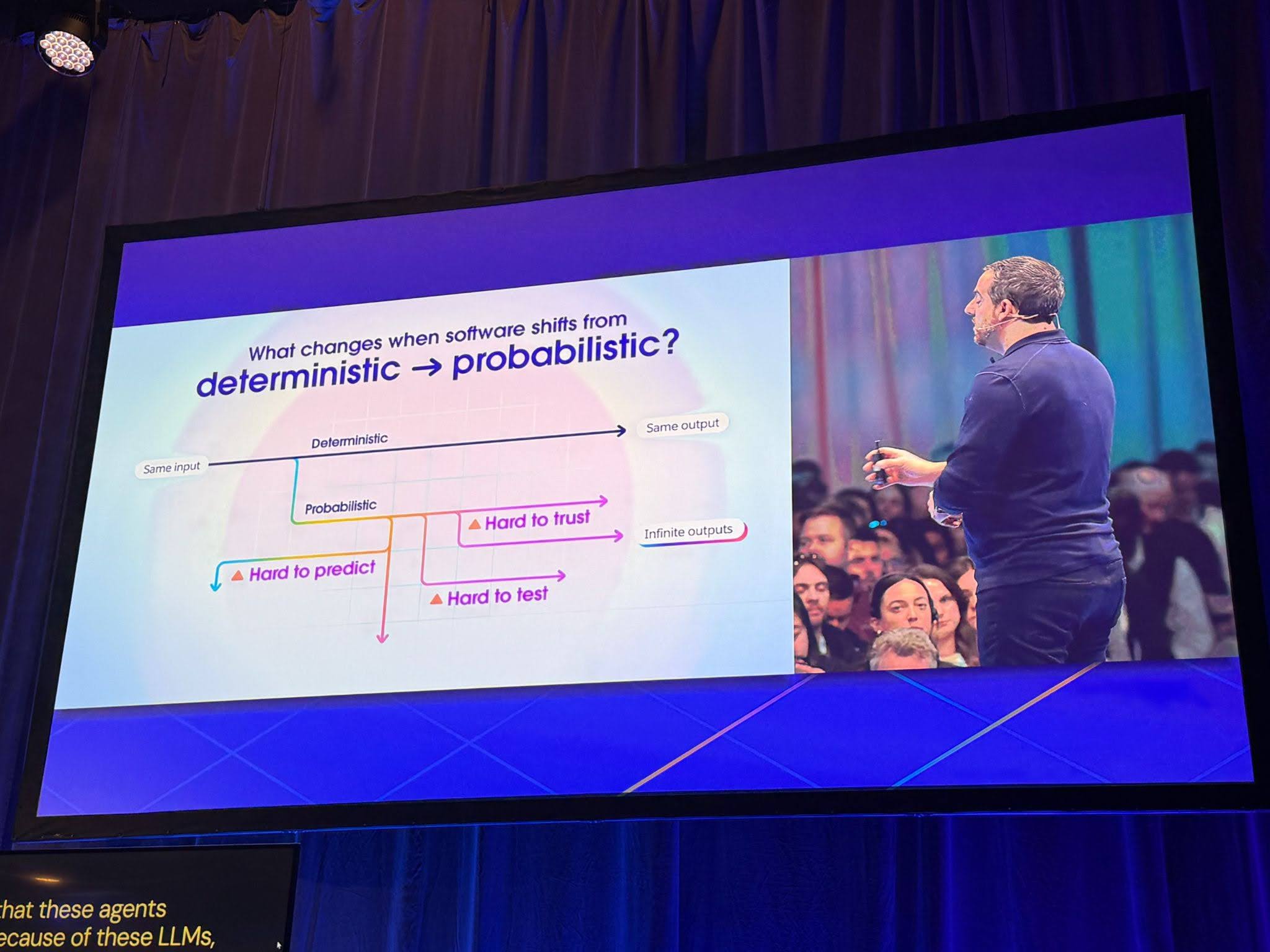
TDX 2026 Salesforce had an honest keynote moment that I really appreciated, a slide titled “What changes when software shifts from deterministic to probabilistic?”
The answer is everything that made traditional software engineering manageable.
A deterministic system (an API, a workflow, a rules engine) gives you the same output for the same input. You can unit test it. You can regression test it. You can set an SLA on it. You know what it will do.
| Same input, infinite possible outputs. Hard to predict. Hard to trust. Hard to test. |
An agentic system does not work that way. Same input, infinite possible outputs. Hard to predict. Hard to trust. Hard to test. These were the exact words on the slide, and they were not there as a disclaimer. They were there as a call to action.
For those of us who have been selling and delivering AI projects, this is the conversation we need to be having with clients from day one. The shift from deterministic to probabilistic is not just a technical change. It is a governance change, a QA change, a risk management change, and a change in how you define “done”.
An API is done when it passes its test suite. An agent is never done in the same sense. You observe it, you measure it, you refine it. The lifecycle is fundamentally different.
The Agentic Lifecycle Has Been Redesigned
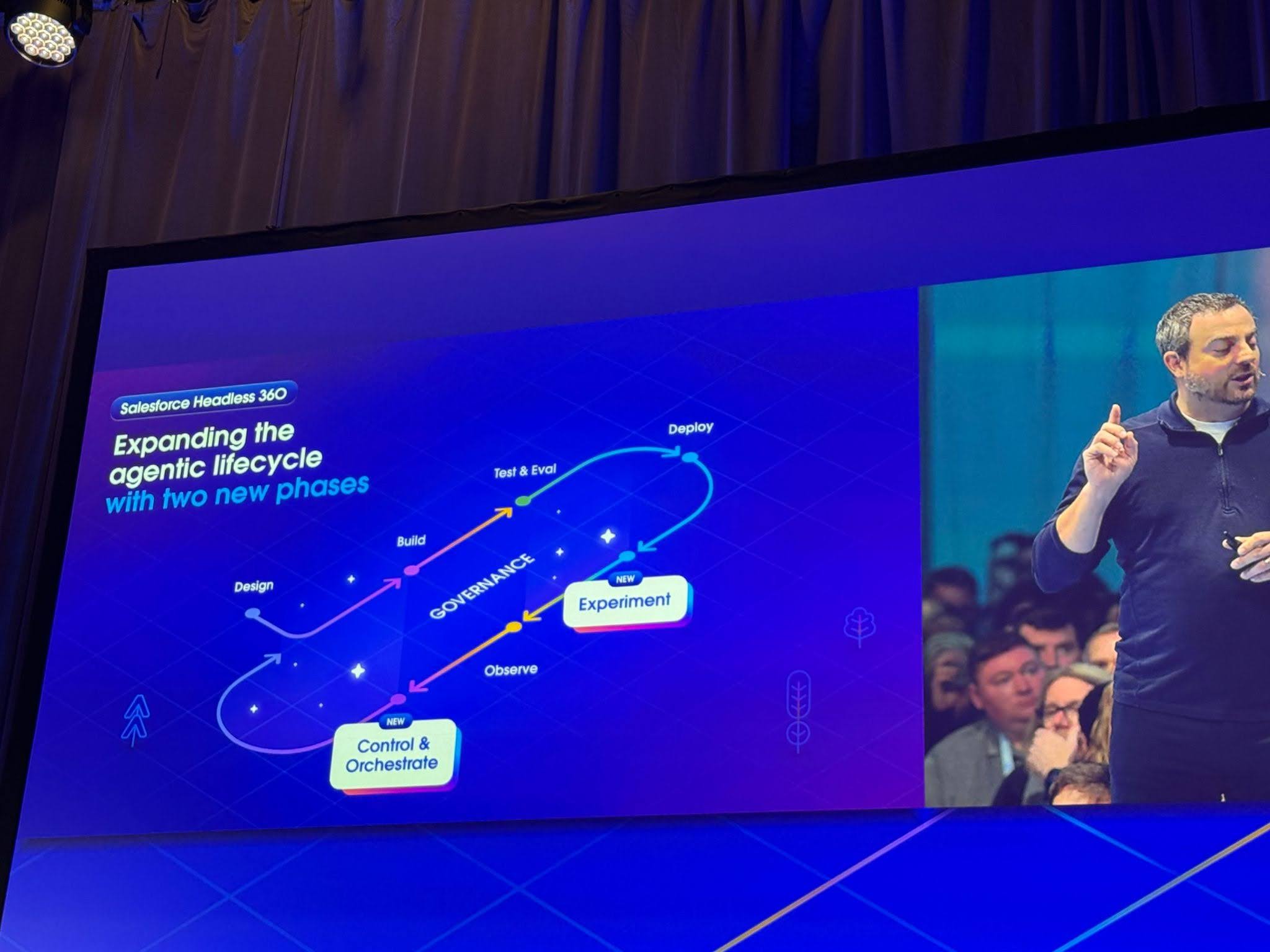
Salesforce formalized something important at TDX 2026 Salesforce, which is the Agentic Lifecycle, expanded with two new phases.
The existing phases (Design, Build, Test and Eval, Deploy, Observe) now have two new additions.
- Control and Orchestrate, which is multi agent coordination, Agent Fabric, A2A protocol (GA now).
- Experiment, which is A/B Testing API for agents (Pilot today).
That last one deserves attention. A/B testing for agents. Because when your output is probabilistic, you cannot just ship version 1 and call it done. You need to compare behavior across versions, measure outcomes, and iterate on intent, not on code.
This is a new discipline. Prompt engineering, evaluation frameworks, behavioral testing. These are not optional extras. They are part of the delivery methodology now.
At Cloudgaia, we have been building this thinking into how we approach agentic projects. TDX 2026 Salesforce confirmed we are moving in the right direction.
Agentforce Vibes 2.0: What You Need to Know
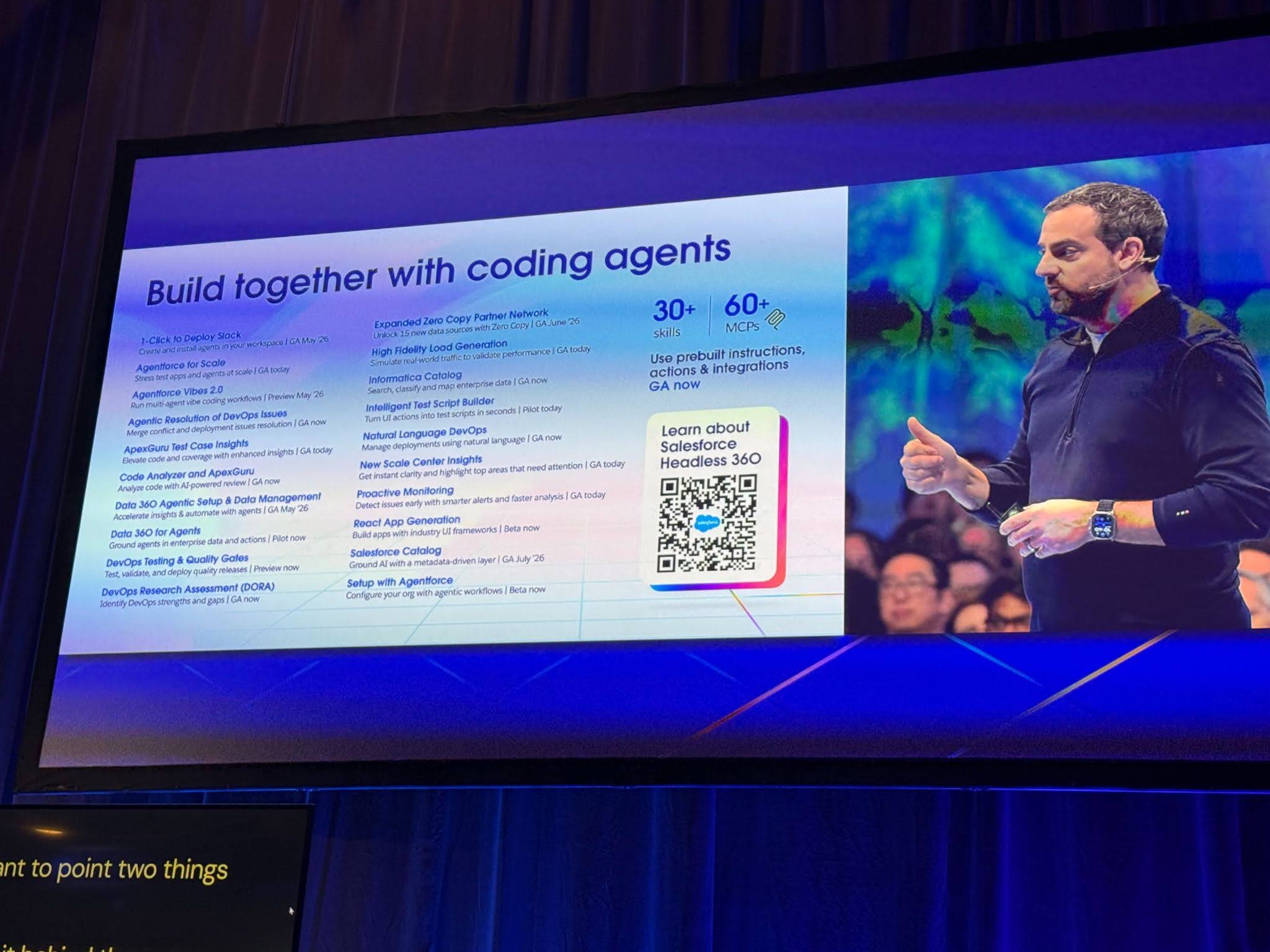
Vibes is the vibe coding tool in the Salesforce ecosystem. Think Cursor but for Salesforce. A few important updates announced at TDX 2026 Salesforce.
- Multi LLM support, which means Vibes 2.0 runs on any LLM, not just Salesforce’s own models. OpenAI, Anthropic, Gemini, open source. You pick.
- Preview May ’26, which means it is not GA yet, but it is coming fast.
- It is now paid, which means the free tier is going away. Worth factoring into your tooling strategy.
The multi LLM angle matters for enterprises that have model commitments or data residency requirements. The ability to run the same agentic coding experience on a different model is a significant unlock.
AgentExchange and the $50M Bet on the Ecosystem
Salesforce announced an updated AgentExchange, now consolidating AppExchange, Slack Marketplace, and the Agentforce ecosystem into one, with over 13,000 agents, tools, and apps available. And alongside that, a $50M Builders Initiative to fund developers and partners bringing new solutions to market.
I want to be honest about why this matters beyond the headline number.
Salesforce is not just building a platform. It is making an economic argument, that the agentic ecosystem needs to be seeded, and they are willing to put money behind it. For partners, this is a signal worth taking seriously. The question is not whether to be in AgentExchange. It is how fast you can get there with something differentiated.
For those of us building vertical solutions and accelerators, the window to claim territory in a less crowded marketplace is right now, before everyone else catches up.
Agentforce Labs: Finally, a Place to See What’s Coming
Salesforce launched Agentforce Labs (labs.agentforce.com), a new site where you can build with experimental features and preview what is being tested before it reaches GA.
This sounds small. It is not.
One of the real frustrations of working in the Salesforce ecosystem is that by the time a feature goes GA, you have already lost months of preparation time. Labs changes that dynamic. It is Salesforce acknowledging that the pace of change is too fast for the traditional release cadence to serve practitioners well.
If you are delivering agentic projects right now, bookmark it. It is the closest thing to a legitimate early warning system the ecosystem has.
React on Salesforce: What It Means for the UI Conversation
I saved this one for here because it connects directly to what I said earlier about APIs being the new UI, and it adds a concrete dimension I did not have before.
Salesforce announced Salesforce Multi Framework, currently in Beta, a runtime that lets you build with ReactJS (more frameworks coming), hosted on Salesforce, with data via GraphQL and full integration with Agentforce Vibes.
Think about what this means for a moment. For years, Salesforce UI development meant LWC. That was the deal. Now you can bring your own component library, your own styling system, your own React ecosystem, and host it natively on Salesforce.
This is not a small concession. It is Salesforce admitting that the walled garden approach to frontend development was costing them developer adoption.
But here is my read. This does not resolve the tension I raised earlier around the Experience Layer. It actually deepens it. Now you have three models for delivering UI on Salesforce, which are LWC, React via Multi Framework, and agent assembled widgets via the Experience Layer. And no clear guidance on when to use which. That is a conversation we will be having with clients for the next two years.
What I Am Taking Back From TDX 2026 Salesforce
TDX 2026 Salesforce was not a “here are some cool features” conference. It was a “the architecture of software is changing” conference.
The practitioners who will do well in this next cycle are the ones who understand both sides of the bridge, which are the traditional patterns that still apply (API layering, integration governance, delivery methodology) and the new realities that demand new thinking (probabilistic outputs, dynamic UI, agentic testing).
The good news is that if you have been doing serious integration and platform work, you are better positioned than you think. The mental models transfer. The patterns adapt.
The interesting work is figuring out exactly how.
| “Salesforce Headless 360 with 60+ MCP tools allows any AI agent to consume Salesforce capabilities through a standard protocol.”
Salesforce Newsroom TDX 2026 Official Announcement, Salesforce Fuente: salesforce.com/news |
Conclusion
TDX 2026 Salesforce was not an event of isolated announcements. It was confirmation that the underlying architecture of the platform is changing, and with it, the role of those of us delivering projects in this ecosystem. MCP, Experience Layer, expanded agentic lifecycle, native React, consolidated AgentExchange. Each is significant. Together, they draw a different landscape.
Fundamentals still matter. Well designed integration patterns, solid governance, serious delivery methodology. Those do not go away. They combine with new thinking about probability, dynamic composition and behavioral testing. That is the conversation we need to be having with our clients, and it is the conversation we at Cloudgaia have been having for some time. TDX 2026 Salesforce only confirmed that we are moving in the right direction.
If your organization is looking to evolve from a traditional implementation model to a scalable and responsible AI strategy, I’d welcome the opportunity to share my perspective.
Frequently Asked Questions (FAQ) About TDX 2026 Salesforce
What is MCP and why is it the most important structural announcement at TDX 2026 Salesforce?
MCP (Model Context Protocol) is a standard protocol that allows any AI agent, from any vendor, to consume Salesforce capabilities directly. With Salesforce Headless 360 and 60+ MCP tools generally available, the platform stops being just a suite of UIs backed by a database and becomes a capability layer consumable by any intelligent system. This changes what it means to integrate with Salesforce and opens multi vendor scenarios that previously required custom connectors, middleware or ETL pipelines, reducing technical complexity and implementation time for enterprise teams.
What is the Agentforce Experience Layer and how does it affect UX design?
The Agentforce Experience Layer, announced in beta for July 2026, allows an agent to interpret user intent, assemble the right widgets, and render experiences across Slack, Teams, ChatGPT, Gemini, Claude or any other surface. This transforms UX design because the work stops being about designing static screens and starts being about designing interaction contracts and component vocabularies that agents can compose dynamically. UX does not disappear, it becomes more abstract and more strategic at the same time, which raises the bar on design leadership.
How does MuleSoft relate to the new agentic architectures presented at TDX 2026 Salesforce?
The MuleSoft three layer model (System, Process and Experience APIs) already separated the channel from the capability, which is exactly what the agentic Experience Layer does. Those working with this pattern have a clear conceptual advantage, because the vocabulary changes but the architectural intent is the same, which is decoupling the what from the where. In agentic architectures, the experience layer goes from being a static API endpoint to a dynamic composition layer driven by the agent, which changes how it is designed, tested and governed.
What does the shift from deterministic to probabilistic software mean for delivery teams?
A deterministic system gives the same output for the same input, which allows unit tests, regression tests and predictable SLAs. An agentic system does not work that way, because the same input can produce infinite possible outputs. This forces a rethink of QA, governance, risk management and the very definition of “done” in a project. An API is done when it passes its test suite, but an agent is never done in the same sense, it is observed, measured and refined continuously. The lifecycle is different and the delivery methodology must adapt from day one.
What changed in the agentic lifecycle with the announcements from TDX 2026 Salesforce?
Salesforce formalized the Agentic Lifecycle expanded with two new phases on top of the existing ones (Design, Build, Test and Eval, Deploy and Observe). The new phases are Control and Orchestrate, which includes multi agent coordination, Agent Fabric and the A2A protocol in general availability, and Experiment, which brings the A/B Testing API for agents in Pilot status. Adding agentic A/B testing acknowledges that with probabilistic outputs you cannot simply ship a version and call it done, you must compare behavior, measure outcomes and iterate on intent rather than code.
What opportunity do AgentExchange and the $50M initiative represent for Salesforce partners?
Salesforce consolidated AppExchange, Slack Marketplace and the Agentforce ecosystem into a single AgentExchange with over 13,000 agents, tools and apps, and launched a $50M Builders Initiative to fund developers and partners. Beyond the headline figure, the message is that Salesforce