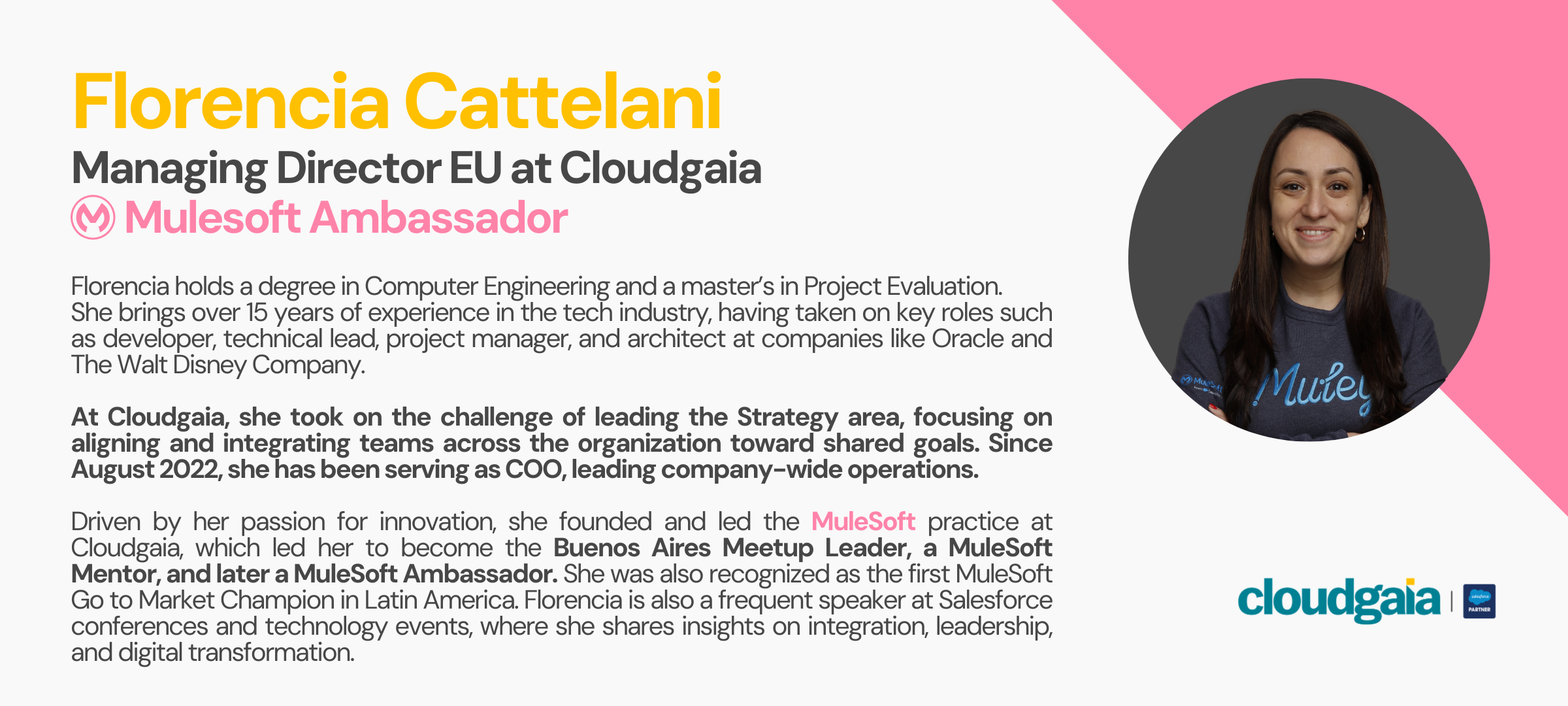

By Florencia Cattelani, Managing Director EU at Cloudgaia
Throughout my 15-year career in technology—from my early days as a developer and architect at companies like Oracle and Disney, to my time as COO and now as Managing Director of Cloudgaia in Europe—I’ve learned one fundamental lesson: the most advanced technology is useless without business purpose and human direction.
Today, tools like Salesforce’s Agentforce are redefining what’s possible in enterprise operations. There’s a lot of discussion about how artificial intelligence can analyze terabytes of data, automate workflows, and even write flawless code. All of that is true. But there’s a fine line between automating operational tasks and generating real impact on the P&L.
AI executes exceptionally well. But it’s humans who must lead.
The Real Challenge in the European Market (FMCG/B2B)
Today’s business challenges cannot be solved by simply turning on an algorithm.
Take the consumer goods (FMCG) industry in Europe as an example. According to McKinsey & Company’s The State of Grocery Retail Europe 2025 report, the sector is facing “low volume growth and sustained pressure on profitability.” At the same time, consumer goods executives identify their top strategic challenges for 2025 as “increased competition for shoppers, declining consumer spending, and growing retailer pressure,” according to Bain & Company’s Consumer Products Report 2025.
The context is complex. A recent Boston Consulting Group (BCG) report shows that 54% of European consumers are pessimistic about their countries’ economies and are actively seeking value, forcing companies to meet demand while aggressively protecting margins.
Can AI solve margin pressure on its own?
No. It requires the strategic redesign that human leadership provides.
How the Technology Partner Role Is Evolving
This is where the role of consulting firms like Cloudgaia has fundamentally shifted.
We are no longer system implementers—we are business architects.
According to McKinsey’s State of AI 2025, high-performing organizations are three times more likely to have fundamentally redesigned their workflows rather than simply layering AI onto existing processes.
Consulting can no longer be about selling “hands on keyboard” to configure software. We must deconstruct current commercial processes and rebuild them with the assumption that up to 50% of tasks will be executed by autonomous agents.
Consultants bring context, strategic direction, and governance guardrails.
AI brings speed.
The Myth of AI in B2B Sales
There is a persistent misconception that AI will replace B2B sales teams. The data shows the opposite.
Corporate sales will continue to be driven by humans. Gartner predicts that by 2026, B2B sales organizations using generative AI will reduce the time spent on prospecting and meeting preparation by more than 50%.
The goal is not to eliminate the salesperson.
In fact, companies using AI in sales are 52% more likely to meet or exceed their targets—precisely because automation removes repetitive tasks and allows sales teams to focus on what truly matters: building relationships and closing deals.
Soft Skills Are the New Hard Skills
In a world where technical execution and coding are increasingly automated, soft skills become the true differentiator.
AI cannot read the tension in a boardroom.
It cannot negotiate with a customer under inflationary pressure.
It cannot inspire a team to transform how they work.
At the end of the day, technology must have a single purpose: to make organizations radically customer-centric. AI gives us back our most valuable resource—time—so we can focus on listening, understanding, and delivering meaningful outcomes for our customers.
Tools will continue to evolve at an unprecedented pace.
But human leadership and empathy remain the most critical “source code” of any organization.
Sources:
McKinsey & Company (2025): The State of Grocery Retail Europe (https://www.mckinsey.com/industries/retail/our-insights/state-of-grocery-europe-report)
Bain & Company (2025): Consumer Products Report (https://www.bain.com/insights/consumer-products-report-2025-reclaiming-relevance-in-the-gen-ai-era/)
BCG (2025): European Consumers Brace for More Uncertainty (https://www.bcg.com/publications/2025/europeans-brace-for-more-uncertainty)
McKinsey & Company (2025): The state of AI in 2025 (https://www.mckinsey.com/capabilities/quantumblack/our-insights/the-state-of-ai)
Gartner (2025): The Role of Artificial Intelligence in Sales (https://www.gartner.com/en/sales/topics/sales-ai)
Let’s Talk Transformation
If your organization is looking to evolve from a traditional implementation model to a scalable and responsible AI strategy, I’d welcome the opportunity to share my perspective.